
Strings · Tata · Plucked
Sitar सितार
The sitar is the long-necked lute of Hindustani music: a gourd body, curved frets you can move, and a set of strings under the frets that ring by themselves when their note is played.1,2
Raag lessons on the sitarPlay the sitar
Fret7SaसाStringMa
Tap a note to hear it and see the fret it is played on. Learn Raag Yaman on the sitar
- Class
- Strings (Tata)
- Sound
- Plucked metal strings over curved frets, with sympathetic strings
- Region
- North India and Pakistan
- Tradition
- Hindustani
Learn to play the sitar
Parts of the sitar
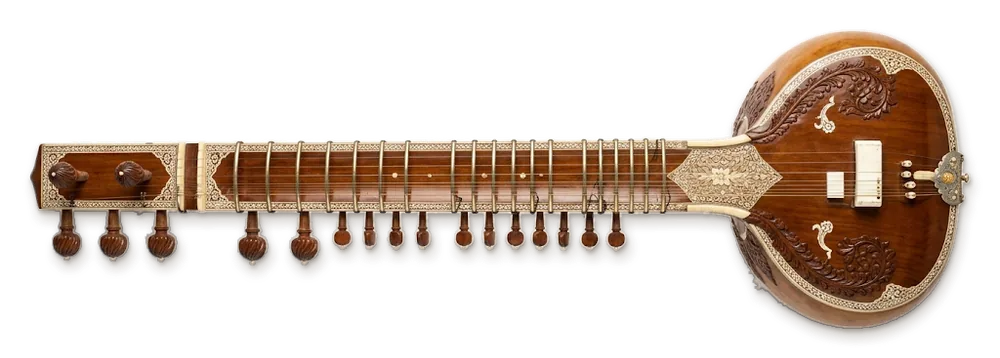
The body is a large dried gourd (kaddu) closed by a wooden faceplate (tabli). Many sitars carry a second, smaller gourd (tumba) near the top of the neck. The neck (dandi) holds curved metal frets (parda) tied on with thread, so a player can slide them to correct the pitch; Courtney notes that the Re and Dha frets in particular are moved from raga to raga.1,2
A sitar has 18 to 21 strings. Six or seven run over the frets; the rest are sympathetic strings (tarafdar) that run under the frets. They are almost never plucked, but ring whenever their note sounds on a played string. Nearly all of the melody is played on one string, the baj tar, while two short drone strings, the chikari, sound the rhythm.1,2
The playing strings cross a wide main bridge with a gently curved top of bone. As a string vibrates it brushes along that curve, which adds the bright, buzzing overtones of the sitar sound. Shaping this curve is called jawari, and many players leave it to an instrument maker.1,2
How the sitar is tuned
There is no single standard tuning: it changes with the school, the player and the raga. The main playing string is almost always tuned to Ma, a fourth above Sa, and the second string to Sa. In the Kharaj Pancham tuning that Ravi Shankar and others use, the chikari strings give high Sa, middle Sa and Pa, and two bass strings give low Sa and low Pa.1
The sympathetic strings are retuned to the notes of each raga. Courtney's beginner tuning puts them on the notes of Bilaval thaat, and raises the Ma strings to tivra Ma for a raga of Kalyan thaat. He suggests Sa on C rather than C♯ or D at first, because slacker strings are easier on new fingers.2
How the sitar is held and played
The player sits on the floor and balances the sitar between the left foot and the right knee, so the hands carry none of its weight. A wire plectrum, the mizrab, is worn on the right index finger; the left hand stops the main string on the frets, usually with the index and middle fingers.1,3
Pulling the string sideways across a fret, called meend, bends a note upward by as much as seven semitones. Vilayat Khan built a singing style of playing, the gayaki ang, on this technique.1
The strokes of the right hand have names, and players combine them like the bols of a drum: Da is the stroke inward, Ra the stroke outward, Dir is the two in quick turn, and Dra is a fast inward and outward pair with the weight on the second.3,4
The sitar in the music
The sitar is above all a solo instrument of Hindustani classical music. It is also heard in film music and fusion, but seldom in South Indian classical music or in folk music.2
A sitar recital moves from a slow alap without a beat into gats, compositions set to a taal. The slow gat style is named after Masit Khan (Masitkhani) and the fast style after Raza Khan (Razakhani).2,5
History of the sitar
The earliest written mention of the sitar is from 1739, in Dargah Quli Khan's Muraqqa-i-Dehli. Most historians now credit an 18th-century musician of the Mughal court, Khusrau Khan, with developing it from the small Persian setar.1
Sources differ on the older story. A popular account names the poet Amir Khusrau, who lived around 1300, as its inventor; Wikipedia calls this tradition discredited and Courtney says it has no basis in historical fact. Roychaudhuri takes a middle line: Amir Khusrau gave the name "sitar" to an existing three-stringed vina but did not invent the instrument. The idea that the sitar grew out of the ancient veena is disputed as well.1,2,5
Strings were added over time. Wikipedia credits Masit Khan with two more strings, Imdad Khan with the first sympathetic strings and Allauddin Khan with the modern seven-string sitar. Roychaudhuri says the chikari strings were copied from the surbahar, and that a bass string for alap was added around 1945.1,5
Players who made the sitar known
- Ravi Shankar: Made the sitar known around the world; plays the Kharaj Pancham tuning.1,2
- Vilayat Khan: Developed the gayaki ang, a way of playing that follows the voice.1
- Imdad Khan: Gave his name to the Imdadkhani style and gharana.1,5
- Allauddin Khan: Credited with the modern seven-string sitar; teacher of the Maihar line.1
Sitar lessons
Short lessons, one skill each, in order. Each one ends with something to practise.
Learn a raga on the sitar
The sitar plays each raga’s own phrases, with where every note is played. In the shruti lessons, compare pitches against a tanpura drone.
- Raag Darbari Kanada on the sitar: komal Ga and komal Dha at its own shruti
- Raag Todi on the sitar: komal Re and komal Ga at its own shruti
- Raag Bhairav on the sitar: komal Re and komal Dha at its own shruti
- Raag Adana on the sitar: Ni at its own shruti
- Raag Bhimpalasi on the sitar: komal Ni at its own shruti
- Raag Miyan ki Malhar on the sitar: komal Ni and shuddha Ni at its own shruti
- Raag Shree on the sitar: komal Re at its own shruti
- Raag Yaman on the sitar
- Raag Bhairavi on the sitar
- Raag Malkauns on the sitar
- Raag Desh on the sitar
- Raag Bageshri on the sitar
- Raag Bhoopali on the sitar
Questions about the sitar
Sources and further reading
The numbers in the text point to these sources. Where they disagree, the text says so.
- Wikipedia contributors. Sitar. Wikipedia.
- David Courtney. Sitar. Chandrakantha.com.
- Wikipedia contributors. Mezrab (plectrum). Wikipedia.
- Sitar maestros demonstrate how the mizrab is more than just a tool with which to strike strings. Scroll.in.
- Bimalakanta Roychaudhuri. The Dictionary of Hindustani Classical Music. Motilal Banarsidass, Delhi, 2000, p. 179–180 ("Sitar").