
Strings · Tata · Drone
Tanpura तानपूरा
Tamil: தம்புரா · Also called tambura, tanpuri
The tanpura plays no melody: its four open strings, plucked in a slow loop, hold Sa in the air for the whole performance.1,3
Play the tanpura
String1 of 4SaसाFingerMiddle
The tanpura plays the same four strings again and again under the raga: Pa (for Yaman), Sa, Sa and low Sa. More about Raag Yaman
- Class
- Strings (Tata)
- Sound
- Four open strings plucked in turn over a buzzing bridge
- Region
- All of India
- Tradition
- Classical
Learn to play the tanpura
Parts of the tanpura
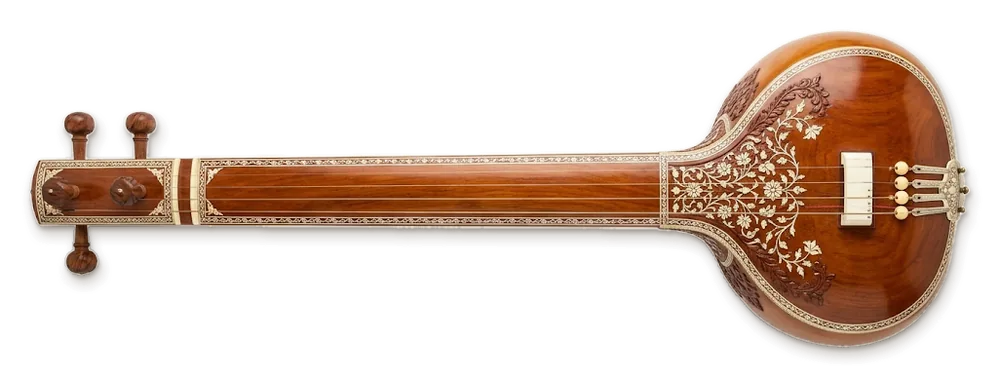
It has a gourd body (tumba), a neck joint (gulu), a soundboard (tabli) and a long neck (dand), but no frets: the strings are always played open. The Miraj style, favoured in Hindustani music, uses a bottle gourd; the Tanjore style of the south is carved entirely from jackwood.1
The strings pass over a wide bridge with a curved top. A cotton thread placed between each string and the bridge shifts where the string touches it, and so tunes the rich buzzing sound called jivari.1,3
How the tanpura is tuned
The standard tuning is Pa, Sa, Sa, Sa: the first string on the low Pa, two middle strings on Sa, and the last string on the low Sa an octave below them. For a raga without Pa the first string goes to Ma; for ragas without Pa and shuddh Ma, such as Marwa, it goes to Ni or Dha.1,2
Sizes follow the voice: larger "male" tanpuras for men, who often take Sa at C♯ or D or lower, and smaller "female" ones about three-quarters the length, since women often sing a fifth higher. There is no fixed pitch in Indian music, so each singer chooses.1
How the tanpura is held and played
The tanpura may be held upright on the right thigh, laid on the floor in front, or held flat on the lap for practice. The middle finger plucks the Pa string, then the index finger plucks the other three in turn, and the cycle repeats.4
The speed of this loop need not follow the rhythm of the music. Tuning is done first with the big pegs, then with fine-tuning beads and finally with the cotton threads.3
The tanpura in the music
It accompanies singers, instrumentalists and dancers, and musicians practise with it every day so their pitch stays true to Sa.1,5
History of the tanpura
A drone-based accompaniment is described in the Natya Shastra, though not under this name, and the Sangita Ratnakara mentions instruments of similar build. Pictures from the 17th century show both the all-wood and the gourd tanpura. Sources differ on the name: some derive it from tumba, the gourd, others from Tumburu, a heavenly musician said to have made it.1,5
Tanpura lessons
Short lessons, one skill each, in order. Each one ends with something to practise.
Questions about the tanpura
Sources and further reading
The numbers in the text point to these sources. Where they disagree, the text says so.
- Wikipedia contributors. Tanpura. Wikipedia.
- David Courtney. Tuning Indian Instruments. Chandrakantha.com.
- The Tanpura: One Note Wonder. Darbar.
- Rama Kausalya. Therapeutic effect (on the tambura), The Hindu, Friday Review, 30 March 2018, as reproduced by carnaticstudent.org. carnaticstudent.org, 2018.
- Bimalakanta Roychaudhuri. The Dictionary of Hindustani Classical Music. Motilal Banarsidass, Delhi, 2000, p. 182–183 ("Tambura").