
Sitar सितार · lesson 1 of 4
Know the sitar and tune it
Name the parts you will touch, learn which string does what, and tune the two main strings to Ma and Sa.
Play the sitar
Fret7SaसाStringMa
Tap a note to hear it and see the fret it is played on. More about Raag Yaman
By the end: You can point to the main string, the drone strings and the sympathetic strings, and tune the first two strings by ear.
Step by step
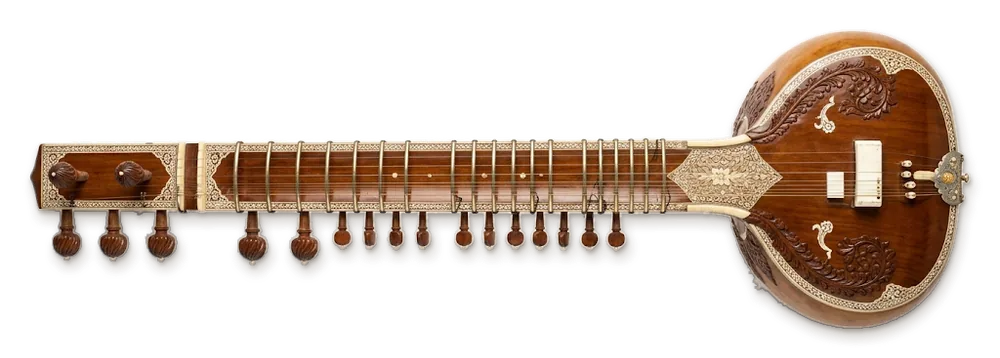
- Learn the parts. The round body is the gourd (kaddu) with its wooden top (tabli); the long neck is the dandi, carrying curved frets (parda) tied on with thread. The playing strings cross the wide main bridge; the sympathetic strings (tarafdar) run below the frets and are almost never plucked.1,2
- Find the main string, the baj tar: nearly all the melody is played on it. The two short chikari strings at the side are struck for rhythm and drone.2
- Choose your Sa. Courtney suggests a low Sa such as C for a beginner, because looser strings are kinder to new fingers than C♯ or D.2
- Tune the main string to Ma, a fourth above Sa, and the second string to Sa. There is no single standard tuning for the other strings; they change with the school and the raga.1,2
- Tune the sympathetic strings last, to the notes of the raga. For practice, Courtney tunes them to Bilaval thaat, and raises the Ma strings to tivra Ma for a raga of Kalyan thaat. When they are right, they ring by themselves as you play. Courtney's general rule: keep to the notes of the raga, and almost any arrangement of these strings will work.1,2,3
Use it on the site
Sources
The numbers in the steps point to these sources. A teacher who can watch you play is still the best guide.
- Wikipedia contributors. Sitar. Wikipedia.
- David Courtney. Sitar. Chandrakantha.com.
- David Courtney. Tuning Indian Instruments. Chandrakantha.com.
All sitar lessons
- Lesson 1 · you are hereKnow the sitar and tune itName the parts you will touch, learn which string does what, and tune the two main strings to Ma and Sa.
More about the sitar: its parts, tuning, history and players.