
Strings · Tata · Plucked, fretless
Sarod सरोद
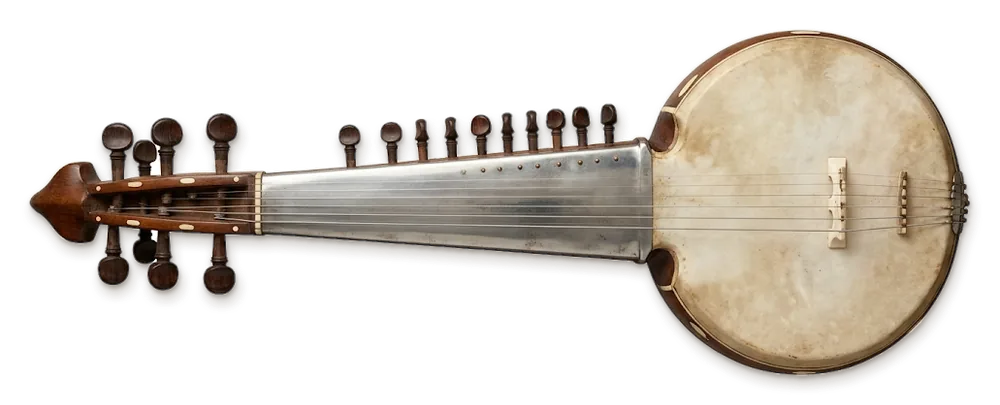
The sarod is a fretless plucked lute with a skin belly and a polished metal fingerboard, known for a deep, weighty sound and long glides between notes.1,2
Raag lessons on the sarodPlay the sarod
StringSaSaसाFinger atOpen
Tap a note to hear it and see where the finger stops the string (“Finger at”: how far down the string from the top). More about Raag Yaman
- Class
- Strings (Tata)
- Sound
- Plucked metal strings over a fretless metal fingerboard and a skin belly
- Region
- North India
- Tradition
- Hindustani
Learn to play the sarod
Parts of the sarod
The usual sarod has 17 to 25 strings: four or five main strings for the melody, one or two drone strings, two chikari strings and nine to eleven sympathetic strings. The body is teak, with goatskin stretched across the round resonator and a metal plate over the fingerboard.1
The strings are plucked with a small triangular plectrum, the java, of polished coconut shell, ebony, horn or similar.1
How the sarod is tuned
On the 25-string Maihar sarod designed by Allauddin Khan and his brother Ayet Ali Khan, the four main strings are tuned Ma, Sa, low Pa and low Sa, which gives three octaves; four more jod strings and two chikari strings (upper Sa) sit beside them, with fifteen sympathetic strings below. Conventional sarods are traditionally tuned to B, the Maihar model to C.1
How the sarod is held and played
With no frets and tight strings, the sarod is hard to play: the strings must be pressed firmly against the fingerboard. Players stop them either with the tips of the fingernails or with nail and fingertip together. Because there are no frets, a player can slide freely between notes (meend).1
The sarod in the music
With the sitar, the sarod is one of the two best-known plucked instruments of Hindustani music. Roychaudhuri explains that steel strings, which replaced gut towards the end of the 19th century, made the notes last long enough for slow alap.1,2
History of the sarod
Its origin is unclear and sources differ. Some scholars trace it to an Indian saradiya veena; others to the Afghan rubab, given metal strings and a metal plate in the 19th century. Two families claim the change from rubab to sarod: the Bangash line of Amjad Ali Khan, and Niamatullah Khan of Lucknow, who began the work in 1855.1,2
Players who made the sarod known
- Allauddin Khan: With his brother Ayet Ali Khan, designed the larger 25-string Maihar sarod.1
- Ali Akbar Khan: Son of Allauddin Khan, and the Maihar sarod's best-known player.3
- Amjad Ali Khan: Plays the conventional sarod of the Bangash line.1
- Radhika Mohan Maitra: Influential player; his followers keep his own sarod design.1
Sarod lessons
Short lessons, one skill each, in order. Each one ends with something to practise.
Learn a raga on the sarod
The sarod plays each raga’s own phrases, with where every note is played. In the shruti lessons, compare pitches against a tanpura drone.
- Raag Darbari Kanada on the sarod: komal Ga and komal Dha at its own shruti
- Raag Todi on the sarod: komal Re and komal Ga at its own shruti
- Raag Bhairav on the sarod: komal Re and komal Dha at its own shruti
- Raag Adana on the sarod: Ni at its own shruti
- Raag Bhimpalasi on the sarod: komal Ni at its own shruti
- Raag Miyan ki Malhar on the sarod: komal Ni and shuddha Ni at its own shruti
- Raag Shree on the sarod: komal Re at its own shruti
Sources and further reading
The numbers in the text point to these sources. Where they disagree, the text says so.
- Wikipedia contributors. Sarod. Wikipedia.
- Bimalakanta Roychaudhuri. The Dictionary of Hindustani Classical Music. Motilal Banarsidass, Delhi, 2000, p. 178 ("Sarod").
- Wikipedia contributors. Ali Akbar Khan. Wikipedia.