
Strings · Tata · Bowed
Sarangi सारंगी
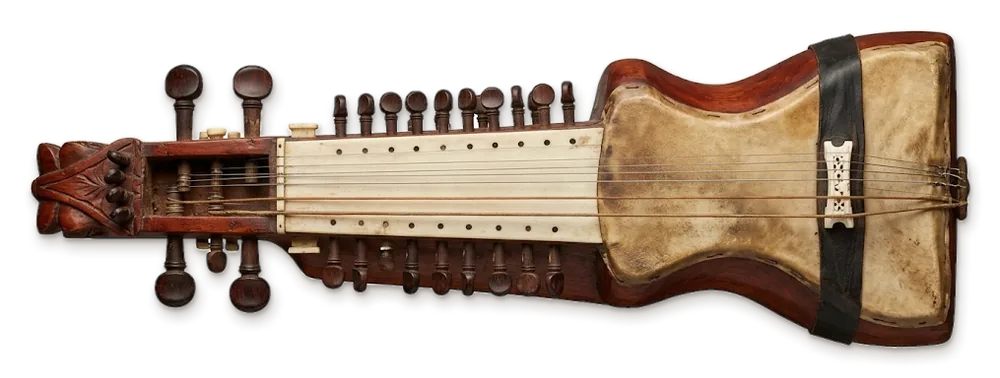
The sarangi is a short bowed instrument carved from one block of wood, prized because it can follow the ornaments of the human voice.1
Raag lessons on the sarangiPlay the sarangi
StringSaSaसाFinger atOpen
Tap a note to hear it and see where the finger stops the string (“Finger at”: how far down the string from the top). More about Raag Yaman
- Class
- Strings (Tata)
- Sound
- Gut strings bowed and stopped with the fingernails
- Region
- North India and Pakistan
- Tradition
- Hindustani
Parts of the sarangi
It is carved from a single block of tun wood, about two feet long, with three hollow chambers called pet (stomach), chaati (chest) and magaj (brain). Goatskin covers the lowest chamber and carries a bridge of bone. Three thick gut strings are bowed; under them run some 35 to 37 sympathetic strings of steel or brass.1
How the sarangi is held and played
The gut strings are bowed with a heavy horsehair bow and stopped not with the fingertips but with the nails, the cuticles and the skin around them, with talcum powder on the fingers so they slide.1
The sarangi in the music
Its music is tied to singing: sarangi players usually know the words of many compositions and follow the structure of a vocal performance. It was long the main accompaniment of khayal; it is also played solo.1,2
History of the sarangi
Roychaudhuri calls it a very old instrument that began in folk music and has been a main accompanying instrument for some five hundred years, and a solo instrument since the early 20th century. Some accounts tie it to Ravana or to the bowed pinaki vina, which he doubts.2
The harmonium took over much of its accompanying role in the 20th century; some listeners still prefer the sarangi for khayal.3
Players who made the sarangi known
Learn a raga on the sarangi
The sarangi plays each raga’s own phrases, with where every note is played. In the shruti lessons, compare pitches against a tanpura drone.
- Raag Darbari Kanada on the sarangi: komal Ga and komal Dha at its own shruti
- Raag Todi on the sarangi: komal Re and komal Ga at its own shruti
- Raag Bhairav on the sarangi: komal Re and komal Dha at its own shruti
- Raag Adana on the sarangi: Ni at its own shruti
- Raag Bhimpalasi on the sarangi: komal Ni at its own shruti
- Raag Miyan ki Malhar on the sarangi: komal Ni and shuddha Ni at its own shruti
- Raag Shree on the sarangi: komal Re at its own shruti
Sources and further reading
The numbers in the text point to these sources. Where they disagree, the text says so.
- Wikipedia contributors. Sarangi. Wikipedia.
- Bimalakanta Roychaudhuri. The Dictionary of Hindustani Classical Music. Motilal Banarsidass, Delhi, 2000, p. 177–178 ("Sarangi").
- Wikipedia contributors. Indian harmonium. Wikipedia.