
Sitar सितार · Raag भैरव
Raag Bhairav on the sitar
Play Raag Bhairav on the sitar
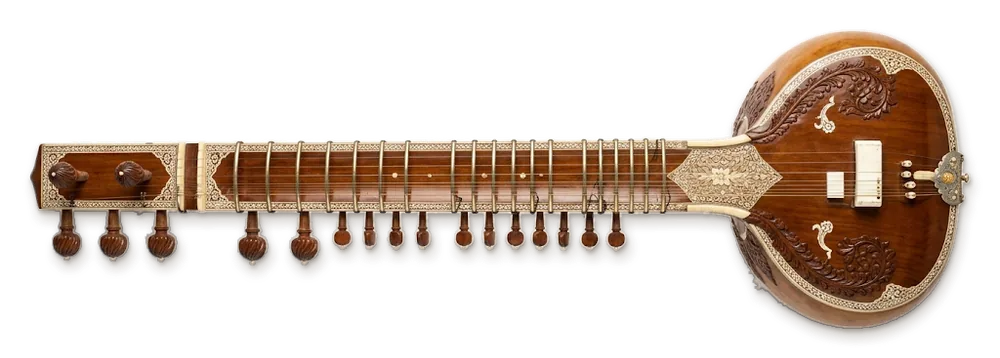
Tap a note to hear it and see the fret it is played on.
Phrases of Raag Bhairav
- S r G m P d N Ṡ , Ṡ N d P m G r S
- S r G m P d N Ṡ
- Ṡ N d P m G r S
- S , G , m P , d , P
- S G , m P , d P , m G , r , G m P , m G , r , S
- S , Gr Gr S , Ṇḍ Ṇ S , Ṇ S G m , G m Gr , S
- S r G m P , P G m Nd , d , P , P GmPGm Gr , r S
- G m Nd , d , P , G m P d N Ṡ , ṙ Ṡ N Ṡ Nd , d , P
- G m Gr , S
- G m Nd , d , P
- S G m P G m , G m Gr , S
Dawn raga and model of Bhairav thaat: komal Re and komal Dha, the other notes shuddh. Vadi komal Dha, samvadi komal Re; sung about 6–9 am.
Tap a phrase to hear it and watch the fret for each note as it sounds. Bhairav is known for its komal Re and komal Dha at its own shruti. Move those notes in the player with the drone on and hear the difference.
The aroha and avaroha1,2,3, pakad1,3 and chalan2,4,5 in the player are the ones on Raag Bhairav’s own page.
Setting the frets for Raag Bhairav
- Two frets change from raga to raga. Bhairav uses komal Re: move the Re fret toward Sa; it uses komal Dha: move the Dha fret toward Pa. Check each moved fret by ear against Sa and the raga's other notes.7,8
- Ga, Ma, Pa and Ni have frets of their own in the middle octave. Above the upper Sa there is one fret each for Re, Ga and Ma: set them to the raga's komal Re, Ga and Ma.8
- Retune the sympathetic strings to the raga's notes (Sa, komal Re, Ga, Ma, Pa, komal Dha and Ni), so they ring whenever the main string plays them.7
- Bhairav's komal Re has no one fixed place in the sources: set the Re fret by ear, a touch lower or higher, against the drone.9,10
- Bhairav's komal Dha has no one fixed place in the sources: set the Dha fret by ear, a touch lower or higher, against the drone.9,10
Where each note of Raag Bhairav is played
The distance from the top nut, as a share of the string’s whole length: a string stopped there sounds the note. The same arithmetic places the finger in the picture.
| Note | Fret | From the nut |
|---|---|---|
| S Sa | Sa fret | 33.3% |
| r komal Re | Re fret, moved toward Sa | 37.0% |
| G Ga | Ga fret | 47.0% |
| m Ma | Ma fret | 50.0% |
| P Pa | Pa fret | 55.5% |
| d komal Dha | Dha fret, moved toward Pa | 58.0% |
| N Ni | Ni fret | 64.6% |
| Ṡ upper Sa | upper Sa fret | 66.6% |
Komal Re and komal Dha in Raag Bhairav, on the sitar
Bhairav's Re is one of the best-known examples of a note with its own shruti. In the descent it is sung with a slow swing (andolan), and Parrikar calls that swinging Re the raga's signature; Dha gets the same treatment.10,12
In the reading of the 22 shrutis on the shrutis page, komal Re has steps at −10 and +12 cents from the keyboard's note. The lesson starts it at the keyboard's note, since the sources do not fix it: move it and listen against the drone. The swing takes it about 40 cents below its place and back, once every 1.1 seconds or so.10
In the reading of the 22 shrutis on the shrutis page, komal Dha has steps at −8 and +14 cents from the keyboard's note. The lesson starts it at the keyboard's note, since the sources do not fix it: move it and listen against the drone. The swing takes it about 40 cents below its place and back, once every 1.1 seconds or so.10
How the sitar plays a note between the keys
The frets are tied on with thread so they can slide, and players shift them to suit the shruti of the raga. Between the frets, the string does the rest: pulled sideways across a fret (meend), it bends a note upward by as much as seven semitones.6,7,9
A pull only ever raises a note above its fret. So a swing (andolan), a gentle movement around the note that touches the shrutis next to it, is a slow pull and release: the note is reached from just below and eased back.6,11
How the sitar plays the notes
Nearly all of the melody is played on one string, the baj tar, tuned to the Ma below Sa. From that low Ma up to the middle Sa, every semitone has a fret of its own. Above Sa there is one fret for Re and one for Dha: for komal Re the Re fret is moved toward Sa, for komal Dha the Dha fret toward Pa, and each new place is checked by ear against the raga's other notes. Komal Ga to Pa, komal Ni, Ni and the upper Sa have frets of their own; above the upper Sa, Re, Ga and Ma have one fret each, set for the raga.6,7,8
Stop the string just behind the fret, mostly with the index finger; the middle finger takes the last note of a phrase or a turn in direction.8
Phrases that make Raag Bhairav
Each one is in the list in the player above, to play on the sitar.
- G m Gr , S: The purvang signature of Bhairav: from Ma the voice slides down to komal Re, which is sung with a slow oscillation (andolan) and a touch of Ga before settling on Sa. Bhatkhande singles out the meend from Ma to Re as especially beautiful.1,4,5
- G m Nd , d , P: The uttarang signature: komal Dha, the vadi, is approached from G m, coloured by a grace of Ni and an andolan, and then resolves onto Pa.3,4,5
- S G m P G m , G m Gr , S: Shows how Re (and often Pa) is skipped or kept very light while ascending, while Ma gets weight and Pa becomes a resting place on the way down.1,4,5
Keep going
- Raag Bhairav: its notes, time, mood, chalan, songs and sheets, played on a keyboard.
- The sitar: its parts, tuning, history and players, with lessons.
- Raag Bhairav on the sarod, the sarangi and the bansuri.
- More ragas on the sitar: Darbari Kanada, Todi, Adana, Bhimpalasi, Miyan ki Malhar, Shree, Yaman, Bhairavi, Malkauns, Desh, Bageshri, Bhoopali.
Sources
The numbers in the text point to these sources. The phrases come from the raga’s own page, with the sources it cites. A teacher who can hear you play is still the best guide.
- V. N. Bhatkhande. Hindustani Sangeet Paddhati: Kramik Pustak Malika, Part 2 (Hindi), section on Bhairav. Part 2, Sangeet Karyalaya, Hathras (publisher Laxminarayan Garg), 1956, p. 164 (shlokas), 165 (description, aroha, avaroha, pakad), 166–172 (compositions).
- V. N. Bhatkhande. Hindustani Sangeet Paddhati: Kramik Pustak Malika, Part 2 (Hindi), Bombay print. Part 2, Published by Ramabai Dattatraya Bhatkhande, Bombay (scan by eGangotri), 1946, p. 168–169 (shlokas, description, Abhinava Raga Manjari paraphrase), 174–175 (lakshan geet).
- David Clarke; music by Vijay Rajput. Rāgs Around the Clock: A Handbook for North Indian Classical Music, section 2.5.1 Rag Bhairav. Open Book Publishers (CC BY-NC-SA), 2024, p. 54–55.
- Rajan P. Parrikar. Bhairav – The Primordial Sound. SAWF (2000); Rajan Parrikar Music Archive, 2000.
- Tanarang (Raag and composition site). Raag Bhairav. tanarang.com.
- Wikipedia contributors. Sitar. Wikipedia.
- David Courtney. Sitar. Chandrakantha.com.
- Nishant Thakar. Sitar tutorial: note names and production. KKSongs, 2009.
- George Howlett. Sitar. Rāga Junglism.
- Wikipedia contributors. Shruti (music). Wikipedia.
- Wikipedia contributors. Andolan. Wikipedia.
- Rajan P. Parrikar. Bhairav – The Primordial Sound. parrikar.org (first published on SAWF), 2000.