
Sitar सितार · Raag यमन
Raag Yaman on the sitar
Play Raag Yaman on the sitar
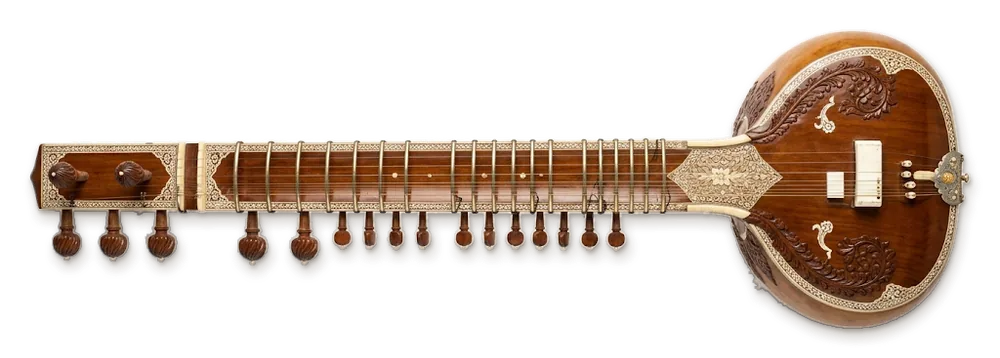
Tap a note to hear it and see the fret it is played on.
Phrases of Raag Yaman
- S R G M P D N Ṡ , Ṡ N D P M G R S
- S R G M P D N Ṡ
- Ṡ N D P M G R S
- Ṇ R G R , S , P M G , R , S
- S R G R S , Ṇ Ḍ P̣ , P̣ Ḍ Ṇ , Ṇ R G , R S
- P M G , R G , R , G M P , M G R , Ṇ R G R , Ṇ R G M P , R S
- Ṇ R G M P , G M P , D D P , M G , R G , P , R , S
- N D P M G M P , N D , M D N D P , M M G G , R R , G G R G , Ṇ R G
- Ṇ R G , Ṇ R M G , M P , M D P N D P M R G R , Ṇ R Ḍ Ṇ S
- Ṇ R G
- P M G , R , S
- Ṇ R G M P
- M D N D P
Early-night raga of Kalyan thaat: all seven notes with tivra Ma, vadi Ga and samvadi Ni. Phrases climb from mandra Ni to Ga and rest there.
Tap a phrase to hear it and watch the fret for each note as it sounds.
The aroha and avaroha1,2,3, pakad2,4 and chalan3,4 in the player are the ones on Raag Yaman’s own page.
Setting the frets for Raag Yaman
- Two frets change from raga to raga. Yaman uses shuddha Re: leave the Re fret in its place; it uses shuddha Dha: the Dha fret stays. Check each moved fret by ear against Sa and the raga's other notes.6,7
- Ga, tivra Ma, Pa and Ni have frets of their own in the middle octave. Above the upper Sa there is one fret each for Re, Ga and Ma: set them to the raga's Re, Ga and tivra Ma.7
- Retune the sympathetic strings to the raga's notes (Sa, Re, Ga, tivra Ma, Pa, Dha and Ni), so they ring whenever the main string plays them.6
Where each note of Raag Yaman is played
The distance from the top nut, as a share of the string’s whole length: a string stopped there sounds the note. The same arithmetic places the finger in the picture.
| Note | Fret | From the nut |
|---|---|---|
| S Sa | Sa fret | 33.3% |
| R Re | Re fret | 40.5% |
| G Ga | Ga fret | 47.0% |
| M tivra Ma | tivra Ma fret | 52.8% |
| P Pa | Pa fret | 55.5% |
| D Dha | Dha fret | 60.3% |
| N Ni | Ni fret | 64.6% |
| Ṡ upper Sa | upper Sa fret | 66.6% |
How the sitar plays the notes
Nearly all of the melody is played on one string, the baj tar, tuned to the Ma below Sa. From that low Ma up to the middle Sa, every semitone has a fret of its own. Above Sa there is one fret for Re and one for Dha: for komal Re the Re fret is moved toward Sa, for komal Dha the Dha fret toward Pa, and each new place is checked by ear against the raga's other notes. Komal Ga to Pa, komal Ni, Ni and the upper Sa have frets of their own; above the upper Sa, Re, Ga and Ma have one fret each, set for the raga.5,6,7
Stop the string just behind the fret, mostly with the index finger; the middle finger takes the last note of a phrase or a turn in direction.7
Phrases that make Raag Yaman
Each one is in the list in the player above, to play on the sitar.
- Ṇ R G: The signature opening: phrases start from mandra Ni and climb through Re to the vadi Ga, rather than starting on Sa. Bhatkhande's pakad and swar-vistar and Tanarang's key phrases all begin this way.2,3,4
- P M G , R , S: The descent passes through tivra Ma to settle on Ga, then Re and Sa; this tivra Ma to Ga step is the sound most listeners recognise as Yaman.2,3,4
- Ṇ R G M P: A straight climb from mandra Ni to Pa through tivra Ma; it is how the raga moves from the lower notes into the middle of the octave.3,4
- M D N D P: From tivra Ma the line often jumps to Dha, skipping Pa, touches Ni and turns back down to Pa; this keeps the upper half from sounding like a plain scale.3,4
Keep going
- Raag Yaman: its notes, time, mood, chalan, songs and sheets, played on a keyboard.
- The sitar: its parts, tuning, history and players, with lessons.
- Raag Yaman on the bansuri.
- More ragas on the sitar: Darbari Kanada, Todi, Bhairav, Adana, Bhimpalasi, Miyan ki Malhar, Shree, Bhairavi, Malkauns, Desh, Bageshri, Bhoopali.
Sources
The numbers in the text point to these sources. The phrases come from the raga’s own page, with the sources it cites. A teacher who can hear you play is still the best guide.
- V. N. Bhatkhande. Hindustani Sangeet Paddhati: Kramik Pustak Malika, Part 1 (Hindi). Part 1, Sangeet Karyalaya, Hathras (later reprint), p. 25–28.
- V. N. Bhatkhande. Hindustani Sangeet Paddhati: Kramik Pustak Malika, Part 2 (Hindi). Part 2, Sangeet Karyalaya, Hathras, 1956, p. 17–18.
- Tanarang (Acharya Vishwanath Rao Ringe 'Tanarang' website). Raag Yaman. tanarang.com.
- V. N. Bhatkhande. Bhatkhande Sangeet Shastra, Bhag 1 (Hindi translation of Hindustani Sangeet Paddhati, vol. 1). Part 1, Sangeet Karyalaya, Hathras, 1956, p. 87, 91–92.
- Wikipedia contributors. Sitar. Wikipedia.
- David Courtney. Sitar. Chandrakantha.com.
- Nishant Thakar. Sitar tutorial: note names and production. KKSongs, 2009.