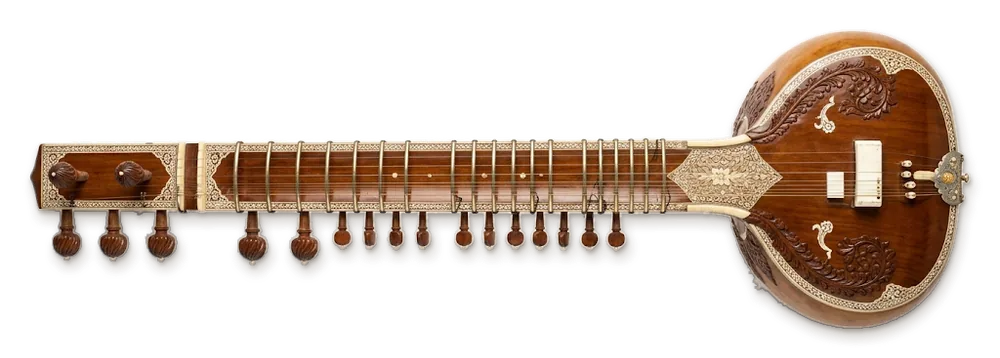
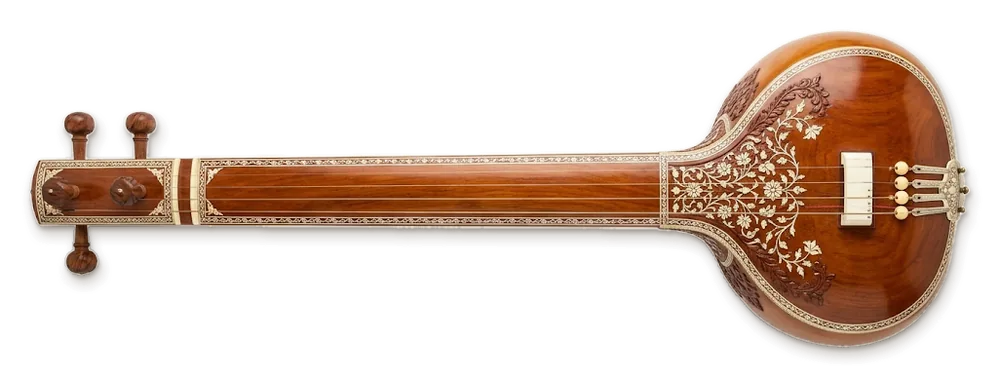
A shruti is the smallest step of pitch that the ear can tell apart and a voice or instrument can produce.1 The old texts count 22 of them in an octave; the seven swaras are chosen from among them.1
Hear the 22 shrutis
Sitar pitches
Tanpura drone
Tap any step to hear its ratio to Sa. One keyboard semitone is 100 cents. The sitar highlights the nearest fret.
Hear two shrutis in succession
Each pair sits near the same keyboard note, one pramana shruti apart (81/80, about 22 cents).
Shruti and swara
A shruti is the finest gradation of pitch on offer; a swara is one of the pitches a musician picks from them to build scales, melodies and ragas. The Natya Shastra discusses 22 shrutis and 7 swaras in each octave.1 Today’s twelve notes (the seven shuddha swaras plus the four komal and one tivra) are one more layer: in performance, a note heard as one of the twelve is a shruti, and the unnamed sounds that glide between them are called nada.1
The idea is found in the Natya Shastra, the Dattilam, Matanga’s Brihaddeshi and Sharngadeva’s Sangita Ratnakara; the Chandogya Upanishad already speaks of an octave divided into 22 parts.1 For Bharata, the author of the Natya Shastra, a shruti is the gap between two notes whose difference can just be heard. Matanga ties it to the ear: the points on a string where the heard note changes are the shrutis.1
Counting the 22 from the bottom, the seven swaras sit on shrutis 4, 7, 9, 13, 17, 20 and 22, each on the last shruti of its own span. So the gaps between neighbouring swaras are 3, 2, 4, 4, 3, 2 and 4 shrutis.1,3
Swara
On shruti
Shrutis from the swara below
Sa षड्ज
4
4 (from Ni below)
Re ऋषभ
7
3
Ga गान्धार
9
2
Ma मध्यम
13
4
Pa पञ्चम
17
4
Dha धैवत
20
3
Ni निषाद
22
2
Bharata’s two veenas
To show that shrutis exist, the Natya Shastra describes two veenas tuned alike, one left fixed and one retuned. The Pa of the second is lowered by one shruti and its other strings are retuned to match; this is done four times. After the second lowering, its Ga and Ni sound with the fixed veena’s Re and Dha; after the third, its Re and Dha with Sa and Pa; after the fourth, its Sa, Ma and Pa with Ni, Ga and Ma.3
Were the 22 steps equal? Dividing the octave into 22 equal parts gives about 54.5 cents each, but te Nijenhuis calls that a purely theoretical sum. She argues that musicians tuned by ear, so the smallest shruti cannot have been an exact interval.3 The current Wikipedia article instead describes three unequal sizes, below. Sources differ.1
Three sizes of step
When the 22 positions are worked out as frequency ratios, the steps between them come in three sizes.1 In cents (1,200 to the octave, 100 to a keyboard semitone):
Name
Ratio
About
How many
poorna (“big”)
256/243
90 cents
7
nyuna (“small”)
25/24
71 cents
5
pramana (“standard”)
81/80
22 cents
10
The poorna is the Pythagorean semitone and the pramana is the small gap known in the West as the syntonic comma.1 Seven poornas, five nyunas and ten pramanas add up to exactly one octave.
One modern reading: the 22 as ratios
Put the three sizes in the order the article gives them and you get the ratios below, the ones the ladder plays. Treat this as one modern reading, not settled fact: the old texts describe shrutis by ear, and later writers have turned them into ratios in different ways.1,2,3,4 A table of nearly the same ratios appears in Konar’s survey of Indian scales, and an earlier version of the Wikipedia article listed them all.2,4
Which step is “the” Re or “the” komal Ga also depends on the writer. A 2015 study, for example, takes Re as 10/9 and komal Ga as 6/5,7 while te Nijenhuis rejects several of the ratios proposed for the old scale and suggests others, such as 11/10 for its Re.3
What measurements of real music found
In 1963 Nazir Jairazbhoy and A. W. Stone measured recorded performances, counting more than 50,000 wave peaks on film. Their footnotes report that Raga Yaman was intoned in different ways, each acceptable, though they called the result provisional because they had studied only two intervals in one raga.5 Wikipedia sums up this line of work: when artists played Yaman on flute, sarangi, sitar and voice, the pitch of a swara was relative, neither rigidly fixed nor random. The same artist pitched the same swara differently at different times, and different artists differed from each other.1,5
Mark Levy’s 1982 study measured performances by leading singers and players with a stroboscopic tuner and looped tape. It compared fourteen performances of Darbari’s komal Ga by several musicians: they differed in detail, yet none could be mistaken for the komal Ga of Kafi. Levy treated his small sample as a pointer to tendencies, not a final answer.6
Later studies point the same way. One analysis reported equal-tempered influence in Hindustani music and intonation closer to just ratios in Carnatic music.7 Some researchers conclude that the in-between notes of today’s ragas do not show a fixed set of 22, partly because musicians use slightly different shrutis in the same raga.1
Ragas known for their shrutis
The best-known example is the extra-flat Ga of Darbari; others are the Re of Bhairav, the Ni of Bhimpalasi and Miyan ki Malhar, and the Ga of Todi.1 For Darbari, Todi and Bhairav, Parrikar stresses that the way a note is approached, often with a slow swing (andolan), matters as much as its height.8,9,10
Darbari's komal Ga is sung low (ati-komal) with a slow swing. Listen for how it is approached, with a touch of Re from below or Ma from above. Komal Dha also takes an andolan.1,8
Todi's Ga is one of the best-known examples of a note with its own shruti. Parrikar stresses how komal Re and komal Ga are voiced and joined, the one gradually melting into the other; without that, he writes, Todi would be lifeless.1,9
Bhairav's Re is one of the best-known examples of a note with its own shruti. In the descent it is sung with a slow swing (andolan), and Parrikar calls that swinging Re the raga's signature; Dha gets the same treatment.1,10
The Ni of Bhimpalasi is named among the best-known examples of a note sung at its own shruti. The sources do not fix its pitch, and singers place such notes slightly differently.1
The Ni of Miyan ki Malhar is named among the best-known examples of a note sung at its own shruti. The sources do not fix its pitch, and singers place such notes slightly differently.1
Listen for the touch of Ga on Shree’s komal Re and the meend that joins Re and Pa in both directions. Those movements shape how Re is heard in the raag.11,12
An instrument whose pitch the player shapes can place a note between the keyboard’s notes. Each lesson here plays a raga’s phrases on one of them and lets you move its own shruti against a tanpura drone; how the instrument does it is on its page: ragas on the sitar, ragas on the sarod, ragas on the sarangi and ragas on the bansuri.
A harmonium cannot do this. Each key sounds one fixed pitch and it cannot slide between notes, so it can neither swing a note nor give a note the shade it has in one raga and not another; for these reasons All India Radio kept it off the air from 1940 to 1971. The musicologist Vidyadhar Oke built a 22-shruti harmonium: Sa and Pa stay fixed, and every other note has a second, higher reed chosen with a knob under its key.13
Questions about shrutis
How many shrutis are there?
The old texts count 22 in an octave, and that number is broadly agreed on today. Researchers who measure real performances find that the in-between notes singers actually use may be fewer or more than 22.1
Is a shruti the same as a swara?
No. A shruti is the smallest step of pitch the ear can tell apart; a swara is one of the seven notes chosen from them to build scales, melodies and ragas.1
Do singers really sing exact shruti ratios?
Measurements say no: the same note is pitched a little differently by different artists, and by the same artist at different times, though not at random. What marks a raga's special note is as much how it is approached and shaken as its exact height.1,5,8
Sources and further reading
The numbers in the text point to these sources. The cents and step counts in the tables are worked out from the ratios.