Sitar सितार · lesson 2 of 4

Hold the sitar and learn the four strokes

Sit with the sitar balanced on the foot and knee, wear the mizrab, and play Da, Ra, Dir and Dra on the open main string.

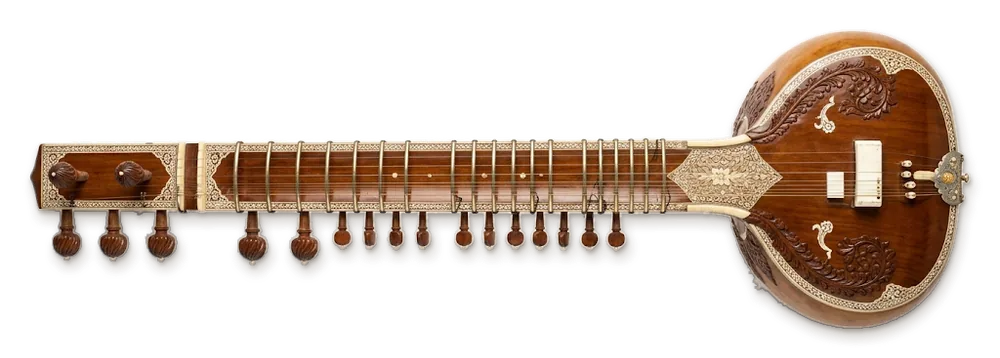
Play the sitar

A sitar seen from above, its long fretted neck to the left and the round gourd to the right.
Fret7SaसाStringMa

Tap a note to hear it and see the fret it is played on. More about Raag Yaman

By the end: You can hold the sitar without gripping it, and play steady Da and Ra strokes on one string.

Step by step

  1. Sit on the floor and balance the sitar between the left foot and the right knee. The instrument should rest by itself, leaving both hands free.1
  2. Wear the mizrab, the wire plectrum, firmly on the tip of the right index finger, so it does not move; it should reach about a quarter of an inch beyond the fingertip.2,3
  3. Play Da, the stroke inward across the main string, and Ra, the stroke outward. Then Dir: the string struck rapidly in both directions. Then Dra: inward and outward very fast, with more weight on the outward stroke.2
  4. Players combine these strokes into longer patterns; together they are the rhythmic vocabulary of instrumental compositions.3

Practise

Even Da and Ra on the open main string2

  • Da Ra Da Ra | Da Ra Da Ra
  • Da - Da Ra | Da - Da Ra

A dash is a held beat. Keep every stroke the same loudness.

Adding Dir and Dra2,3

  • Dir Da Dir Da | Ra Da Da Ra
  • Da Dra Da Ra | Da Dra Da Ra

Begin slowly; speed comes once each stroke is clean.

Sources

The numbers in the steps point to these sources. A teacher who can watch you play is still the best guide.

  1. Wikipedia contributors. Sitar. Wikipedia.
  2. Wikipedia contributors. Mezrab (plectrum). Wikipedia.
  3. Sitar maestros demonstrate how the mizrab is more than just a tool with which to strike strings. Scroll.in.

All sitar lessons

More about the sitar: its parts, tuning, history and players.