
Sitar सितार · Raag देस
Raag Desh on the sitar
Play Raag Desh on the sitar
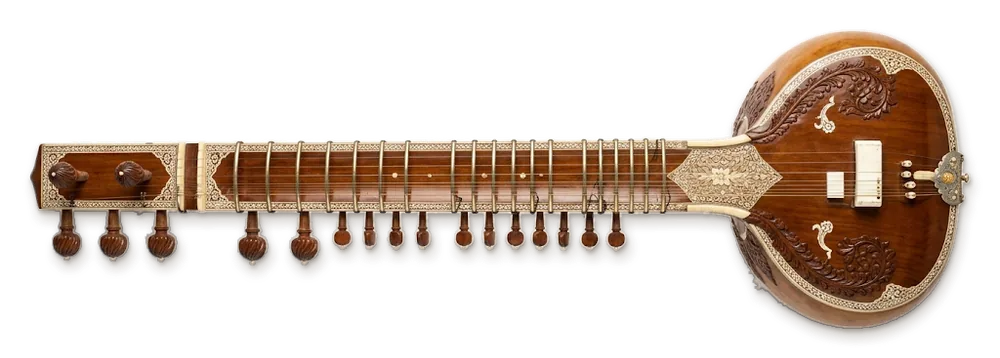
Tap a note to hear it and see the fret it is played on.
Phrases of Raag Desh
- S R m P N Ṡ , Ṡ n D P m G R G S
- S R m P N Ṡ
- Ṡ n D P m G R G S
- R R , m P , n D P , P D P m G R G S
- G m G R , G S , R R , G S
- G m P D P m G , R G S , R R m P , n D P
- m m , P P , N , Ṡ , N Ṡ , Ṙ Ṡ , n D P
- P Ṡ , N Ṡ , n D P , Ġ ṁ Ġ Ṙ Ġ Ṡ , N Ṡ
- Ṙ Ṙ , Ṡ Ṡ , n D P , Ṡ n D P , D m , G R G S
- R m P n D P
- R R m P
- R m P N Ṡ
- Ṡ n D P
- P D P m G R G S
- D⁀m⁀G R
- R G Ṇ S
Night raga of Khamaj thaat: Ga and Dha are left out going up, with shuddh Ni rising and komal Ni falling. Vadi Re, samvadi Pa; sung about 9 pm–midnight.
Tap a phrase to hear it and watch the fret for each note as it sounds.
The aroha and avaroha1,2,3,4, pakad3,4 and chalan3,4,5 in the player are the ones on Raag Desh’s own page.
Setting the frets for Raag Desh
- Two frets change from raga to raga. Desh uses shuddha Re: leave the Re fret in its place; it uses shuddha Dha: the Dha fret stays. Check each moved fret by ear against Sa and the raga's other notes.7,8
- Ga, Ma, Pa, komal Ni and Ni have frets of their own in the middle octave. Above the upper Sa there is one fret each for Re, Ga and Ma: set them to the raga's Re, Ga and Ma.8
- Retune the sympathetic strings to the raga's notes (Sa, Re, Ga, Ma, Pa, Dha, komal Ni and Ni), so they ring whenever the main string plays them.7
Where each note of Raag Desh is played
The distance from the top nut, as a share of the string’s whole length: a string stopped there sounds the note. The same arithmetic places the finger in the picture.
| Note | Fret | From the nut |
|---|---|---|
| S Sa | Sa fret | 33.3% |
| R Re | Re fret | 40.5% |
| G Ga | Ga fret | 47.0% |
| m Ma | Ma fret | 50.0% |
| P Pa | Pa fret | 55.5% |
| D Dha | Dha fret | 60.3% |
| n komal Ni | komal Ni fret | 62.5% |
| N Ni | Ni fret | 64.6% |
| Ṡ upper Sa | upper Sa fret | 66.6% |
How the sitar plays the notes
Nearly all of the melody is played on one string, the baj tar, tuned to the Ma below Sa. From that low Ma up to the middle Sa, every semitone has a fret of its own. Above Sa there is one fret for Re and one for Dha: for komal Re the Re fret is moved toward Sa, for komal Dha the Dha fret toward Pa, and each new place is checked by ear against the raga's other notes. Komal Ga to Pa, komal Ni, Ni and the upper Sa have frets of their own; above the upper Sa, Re, Ga and Ma have one fret each, set for the raga.6,7,8
Stop the string just behind the fret, mostly with the index finger; the middle finger takes the last note of a phrase or a turn in direction.8
Phrases that make Raag Desh
Each one is in the list in the player above, to play on the sitar.
- R R m P: The usual opening and the first half of Bhatkhande's pakad. Re is struck twice and joined straight to Pa through Ma. Re to Pa is Desh's main axis.3,4,5
- R m P N Ṡ: The ascent leaves out Ga and Dha and climbs to taar Sa on shuddh Ni.1,2,5
- Ṡ n D P: Coming down, Ni turns komal. Shuddh Ni going up and komal Ni coming down is one of the clearest marks of the raga.1,4,5
- P D P m G R G S: The second half of the pakad. Dha and Ga, missing from the ascent, appear here, and Ga is touched on the way to Re and again on the way to Sa.1,3,4
- D⁀m⁀G R: A smooth glide from Dha through Ma that only grazes Ga before settling on Re. This lightly sounded Ga is what separates Desh from its older parent Sorath.2,3,5
- R G Ṇ S: A typical close: from Re through a touch of Ga down to mandra Ni and home to Sa.1,3,5
Keep going
- Raag Desh: its notes, time, mood, chalan, songs and sheets, played on a keyboard.
- The sitar: its parts, tuning, history and players, with lessons.
- Raag Desh on the bansuri.
- More ragas on the sitar: Darbari Kanada, Todi, Bhairav, Adana, Bhimpalasi, Miyan ki Malhar, Shree, Yaman, Bhairavi, Malkauns, Bageshri, Bhoopali.
Sources
The numbers in the text point to these sources. The phrases come from the raga’s own page, with the sources it cites. A teacher who can hear you play is still the best guide.
- Tanarang (tanarang.com). Raag Des. tanarang.com.
- Joep Bor (ed.), Suvarnalata Rao, Wim van der Meer, Jane Harvey. The Raga Guide: A Survey of 74 Hindustani Ragas. Nimbus Records with Rotterdam Conservatory of Music, 1999, p. 60 (Desh).
- George Howlett (Rāga Junglism). Raag Desh (Hindustani Raga Index). ragajunglism.org.
- V. N. Bhatkhande. Bhatkhande Sangeet Shastra, Bhag 1 (Hindi translation of Hindustani Sangeet Paddhati, vol. 1). Part 1, Sangeet Karyalaya, Hathras, 1956, p. 238–239 (Desh and Sorath, pakad), 242 (Desh swar vistar), 243 (time of Sorath-anga ragas).
- Rajan P. Parrikar. Des: Tunes from the Countryside. parrikar.org, first published on SAWF, 1 Oct 2001 (read via the Internet Archive copy), 2001.
- Wikipedia contributors. Sitar. Wikipedia.
- David Courtney. Sitar. Chandrakantha.com.
- Nishant Thakar. Sitar tutorial: note names and production. KKSongs, 2009.