
Sitar सितार · Raag मियाँ की मल्हार
Raag Miyan ki Malhar on the sitar
Play Raag Miyan ki Malhar on the sitar
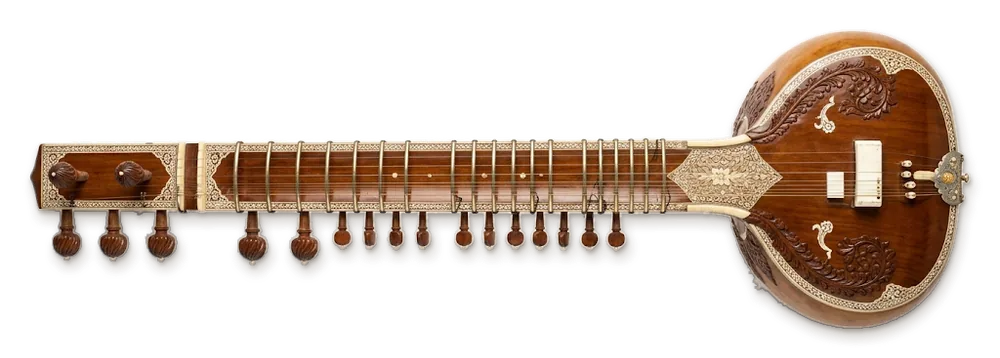
Tap a note to hear it and see the fret it is played on.
Phrases of Raag Miyan ki Malhar
- R m R S , m R , P , n D , N Ṡ , Ṡ n P , m P , g m , R S
- R m R S , m R , P , n D , N Ṡ
- Ṡ n P , m P , g m , R S
- R m R S , ṇ P̣ ṃ P̣ , ṇ Ḍ , Ṇ S , P , g m R S
- S , Ṇ , ṇ Ḍ Ṇ , Ṇ S
- m mR mR P , m P mg mg m R , S
- m P n D n D N , N Ṡ , Ṡ D n m P
- m P D N Ṡ , Ṡ Ṙ Ṡ , D n m P , n n P m P mg
- P mg mg m R , R S
- m mR mR P
- S , ṇ Ḍ Ṇ , Ṇ S
- m P n D N Ṡ
- R P mg — m R , S
- n P m P
- Ṡ n P , m P , g m R S
Monsoon raga of Kafi thaat attributed to Tansen: komal Ga, both Nis and the m R P move. Vadi Ma, samvadi Sa; sung at midnight or any time in the rains.
Tap a phrase to hear it and watch the fret for each note as it sounds. Miyan ki Malhar is known for its komal Ni and shuddha Ni at its own shruti. Move those notes in the player with the drone on and hear the difference.
The aroha and avaroha1,2,3, pakad1,2,3,4 and chalan5,6 in the player are the ones on Raag Miyan ki Malhar’s own page.
Setting the frets for Raag Miyan ki Malhar
- Two frets change from raga to raga. Miyan ki Malhar uses shuddha Re: leave the Re fret in its place; it uses shuddha Dha: the Dha fret stays. Check each moved fret by ear against Sa and the raga's other notes.8,9
- Komal Ga, Ma, Pa, komal Ni and Ni have frets of their own in the middle octave. Above the upper Sa there is one fret each for Re, Ga and Ma: set them to the raga's Re, komal Ga and Ma.9
- Retune the sympathetic strings to the raga's notes (Sa, Re, komal Ga, Ma, Pa, Dha, komal Ni and Ni), so they ring whenever the main string plays them.8
- Miyan ki Malhar's komal Ni has no one fixed place in the sources: set the komal Ni fret by ear, a touch lower or higher, against the drone.10,11
- Miyan ki Malhar's Ni has no one fixed place in the sources: set the Ni fret by ear, a touch lower or higher, against the drone.10,11
Where each note of Raag Miyan ki Malhar is played
The distance from the top nut, as a share of the string’s whole length: a string stopped there sounds the note. The same arithmetic places the finger in the picture.
| Note | Fret | From the nut |
|---|---|---|
| S Sa | Sa fret | 33.3% |
| R Re | Re fret | 40.5% |
| g komal Ga | komal Ga fret | 43.9% |
| m Ma | Ma fret | 50.0% |
| P Pa | Pa fret | 55.5% |
| D Dha | Dha fret | 60.3% |
| n komal Ni | komal Ni fret | 62.5% |
| N Ni | Ni fret | 64.6% |
| Ṡ upper Sa | upper Sa fret | 66.6% |
Komal Ni and shuddha Ni in Raag Miyan ki Malhar, on the sitar
The Ni of Miyan ki Malhar is named among the best-known examples of a note sung at its own shruti. The sources do not fix its pitch, and singers place such notes slightly differently.11
In the reading of the 22 shrutis on the shrutis page, komal Ni has steps at −4 and +18 cents from the keyboard's note. The lesson starts it at the keyboard's note, since the sources do not fix it: move it and listen against the drone.11
In the reading of the 22 shrutis on the shrutis page, Ni has steps at −12 and +10 cents from the keyboard's note. The lesson starts it at the keyboard's note, since the sources do not fix it: move it and listen against the drone.11
How the sitar plays a note between the keys
The frets are tied on with thread so they can slide, and players shift them to suit the shruti of the raga. Between the frets, the string does the rest: pulled sideways across a fret (meend), it bends a note upward by as much as seven semitones.7,8,10
A pull only ever raises a note above its fret. So a swing (andolan), a gentle movement around the note that touches the shrutis next to it, is a slow pull and release: the note is reached from just below and eased back.7,12
How the sitar plays the notes
Nearly all of the melody is played on one string, the baj tar, tuned to the Ma below Sa. From that low Ma up to the middle Sa, every semitone has a fret of its own. Above Sa there is one fret for Re and one for Dha: for komal Re the Re fret is moved toward Sa, for komal Dha the Dha fret toward Pa, and each new place is checked by ear against the raga's other notes. Komal Ga to Pa, komal Ni, Ni and the upper Sa have frets of their own; above the upper Sa, Re, Ga and Ma have one fret each, set for the raga.7,8,9
Stop the string just behind the fret, mostly with the index finger; the middle finger takes the last note of a phrase or a turn in direction.9
Phrases that make Raag Miyan ki Malhar
Each one is in the list in the player above, to play on the sitar.
- m mR mR P: The Malhar signature shared by the whole family. From Ma the voice falls to Re with a glide, Re is sounded with a touch of Ma above it (often twice), and then it leaps straight up to Pa. Bhatkhande singles out the Re–Pa pairing and the fall from Ma to Re as what marks a Malhar; the plain notes m R P also occur in other ragas, so the way Re is sung is what matters.4,5,6
- S , ṇ Ḍ Ṇ , Ṇ S: The two-Ni signpost of Miyan ki Malhar. Komal Ni comes first and falls to Dha; shuddh Ni follows and rises to Sa. Komal Ni always leans down, shuddh Ni always leads up, and Dha sits between them as a pivot. Bhatkhande says teachers make students drill this low turn carefully, and he notes a grace of Dha on each Ni.2,3,4,5
- m P n D N Ṡ: The same two-Ni turn one octave up: the usual climb to the upper Sa, and the way many antaras begin. Bhatkhande's own Sanskrit verse names this phrase as the raga's distinctive limb. A direct m P D N S' is also used.3,4,5
- R P mg — m R , S: The Kanada side. From Re or Pa the voice comes down to komal Ga and holds it with a slow, wide oscillation (andolan) that brushes Ma above, then resolves m R S. Bhatkhande asks for the Ga to be shaken two or three times; Parrikar compares it to the descending Ga of Darbari Kanada.1,4,5
- n P m P: The Ni–Pa pairing: komal Ni drops straight to Pa, and Ma–Pa answers. With the Re–Pa and Ni–Dha pairings it is one of the connections Bhatkhande lists as typical of the raga.1,4,5
- Ṡ n P , m P , g m R S: The descent: komal Ni down to Pa with no Dha, a short Ma–Pa turn, then the oscillated Ga resolving to Re and Sa.1,3
Keep going
- Raag Miyan ki Malhar: its notes, time, mood, chalan, songs and sheets, played on a keyboard.
- The sitar: its parts, tuning, history and players, with lessons.
- Raag Miyan ki Malhar on the sarod, the sarangi and the bansuri.
- More ragas on the sitar: Darbari Kanada, Todi, Bhairav, Adana, Bhimpalasi, Shree, Yaman, Bhairavi, Malkauns, Desh, Bageshri, Bhoopali.
Sources
The numbers in the text point to these sources. The phrases come from the raga’s own page, with the sources it cites. A teacher who can hear you play is still the best guide.
- V. N. Bhatkhande; ed. Dharitri Ray and Asimkumar Chattopadhyay. Hindusthani Sangeet-Paddhati, vol. 9 (Bengali translation of Bhatkhande's Kramik Pustak Malika material): chapter 'Raag Miyan Malhar' (Sanskrit verses, rules, aroha, avaroha, pakad, compositions). Part 9, Dipayan, Calcutta, 1991, p. 75–78.
- Tanarang (Pt. Vishwanath Rao Ringe 'Tanarang'). Raag Malhar (Raag Miya Malhar). tanarang.com.
- Darbar. Miyan ki Malhaar (Raga explorer). darbar.org.
- V. N. Bhatkhande; ed. Laxminarayan Garg. Bhatkhande Sangeet Shastra (Hindi translation of Hindustani Sangeet Paddhati), Bhag 4: Miyan ki Malhar. Part 4, Sangeet Karyalaya, Hathras, 1957, p. 368–377; 776–778 (summary of the Malhar anga).
- Rajan P. Parrikar. On Gaud Malhar and Miyan Malhar. parrikar.org (first published on SAWF, 1 Apr 2002), 2002.
- George Howlett. Raag Miyan ki Malhar. ragajunglism.org.
- Wikipedia contributors. Sitar. Wikipedia.
- David Courtney. Sitar. Chandrakantha.com.
- Nishant Thakar. Sitar tutorial: note names and production. KKSongs, 2009.
- George Howlett. Sitar. Rāga Junglism.
- Wikipedia contributors. Shruti (music). Wikipedia.
- Wikipedia contributors. Andolan. Wikipedia.