
Tal Parichay, first prakar
1Ta Kaतकsam
2Dhiधि
3ऽऽ
4Dhaधाtali
5Geगे
6Tiतिtali
7ऽऽ
The same strokes as the theka, begun from TaKa; claps on 1, 4 and 6.1
Taal · 7 matras
Pashto is a 7-matra tabla taal in vibhags of 3, 2 and 2, with claps on matras 1, 4 and 6 and no khali; it accompanies Punjabi-style songs and qawwali.
Also written: Pashtu, Pushto, Peshto
× is sam, the first beat, where you clap. A number is another clap (tali); 0 is khali, where you wave the hand instead. Set Tabla Sa to the Sa of your harmonium or tanpura to practise along.
Ti: right hand Tin
Play the tabla
The theka is the basic pattern of tabla bols that marks out one cycle of the taal. Play it at the top of the page and follow the beat.1,4
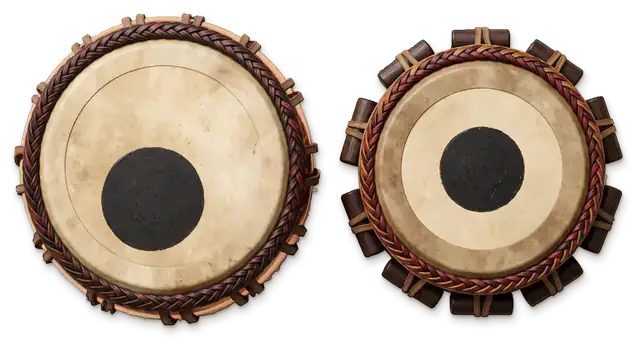
Each bol is one stroke, or two struck together: the right hand on the dayan, the smaller drum, and the left hand on the bayan, the bigger one. An open stroke lifts off so the drum rings; a closed stroke stays down, so the sound stops at once. Tap a bol to hear it and see where the fingers land on the drums.
right hand Tin (open)
Ta: right hand Na (open); then Ka: left hand Ka (closed)
right hand Tin (open) + left hand Ge (open)
right hand Na (open) + left hand Ge (open)
left hand Ge (open)
Open. Index finger strikes the rim (kinar) and lifts; the ring and little fingers rest on the edge of the black patch. Bright and ringing, and soon gone.
Open. Index finger strikes the open skin just outside the black patch and lifts; the ring and little fingers rest as for Na. A softer tone that rings longer than Na.
Open. Index finger strikes the middle of the black patch (syahi) and lifts at once, with no finger resting. A deep, singing ring.
Open. The four fingers together strike the black patch and lift at once, so the drum rings under a soft slap.
Closed. Middle and ring fingers strike the middle of the black patch and stay down. Short and dry. Inside quick runs such as TiRaKiTa and TiTa; the Ta at the end of TiRaKiTa and KiTa is the same dry stroke, often with the ring and little fingers at the edge of the patch.
Closed. Index finger strikes the black patch and stays down. Short and dry, a little brighter than Ti.
Open. Middle and ring fingers strike the open skin beyond the black patch and lift, the wrist resting on the head. The bass rings.
Open. Ge, then the heel of the hand presses forward on the head so the bass slides up in pitch. Players add this slide by choice, often on the last bass stroke before sam; a written Ghe is usually a plain Ge.
Closed. The flat hand slaps the bayan and stays down. No ring, no bass.
Clap on matra 1 (sam), clap on 4 and clap on 6: three claps and no wave, as Tal Parichay, Sangeet Visharad and Ma'arif-un-Naghmat mark it. Count 1 2 3 | 4 5 | 6 7 with the bols: Ti on the first clap, nothing on 2, TaKa on 3, Dhi on the second clap, nothing on 5, Dha on the third clap and Ge on 7.
With no wave anywhere, sam is kept by the first clap and by the bols: the cycle closes on Dha Ge, both drums with the bass open, and turns over onto Ti, a stroke of the dayan alone. The Art of Tabla Playing marks matra 1 as khali instead, the way Rupak is counted; players who follow it wave on 1 and clap on 4 and 6.
| Bol | How it is played |
|---|---|
| Ti | dayan only. Tal Parichay writes ति, which Tal Prakash plays as a closed stroke pressed into the middle of the syahi (middle finger in the Delhi and Ajrada style, middle and ring fingers together in the Purab style). Sangeet Visharad and the Art of Tabla Playing write Tin (तिं): the ring finger rests at the edge of the syahi while the index strikes the lav beside it and lifts at once, so it rings.5,6,7 |
| TaKa | two strokes in one matra. Ta: dayan, ring finger resting at the edge of the syahi, index fingertip strikes the chanti (rim); in a theka it is played damped. Ka: bayan, a flat slap of the joined fingers and thumb on the syahi while the heel of the palm stays down; closed, no ring.5,6 |
| Dhi | both drums: the open Tin of the dayan together with Ga or Gha on the bayan (Tal Prakash's Dhin).5,7 |
| Dha | both drums: Na or Ta on the chanti of the dayan together with Ga or Gha on the bayan.5,7 |
| Ge | bayan only, open: the heel of the palm rests on the front of the syahi and the middle and ring fingers (or index and middle) strike the lav between the syahi and the rim and lift at once, so the bass booms.5,6 |
Layakari fits the theka more than once into one cycle. Here the whole theka is repeated, starting on sam: twice for dugun, three times for tigun and four times for chaugun. Bols under one arc share a matra. Play keeps the matra at the tempo set at the top of the page, so the bols come two, three or four times as fast.
Pashto is a seven-matra taal of the tabla, counted 3 + 2 + 2. Its theka, Ti - TaKa | Dhi - | Dha Ge, leaves the second and fifth matras empty, so the cycle moves with a light, skipping lilt instead of an even run of strokes. Tal Parichay calls its nature very lively (chanchal) and says its outline is the same as that of Rupak.
It is mostly heard in lighter music. Tal Parichay ties it to songs sung in the Punjabi manner and does not count it a taal for solo playing; Sangeet Visharad names it, beside Rupak and the Qawwali theka, among the taals most used in qawwali; and the ethnomusicologist James Kippen places it with Dadra, Qawwali and Kaherva as the short cycles in which the popular ghazal was more often set. Tal Prakash discusses Pashto together with Rupak and Tivra, which also have seven matras, and notes that peshkar and kayda are played in Pashto as in Rupak.
Tal Parichay (part 2) names Pashto among the taals it credits to Amir Khusrau, with Ada Chautal, Trital, Sulfak, Jhoomra and Sawari. Sangeet Visharad, in its survey of music history, lists Pashto in the same company: Jhoomra, Ada Chautala, Sulfak, Farodast and Sawari. James Kippen describes pashto as a folk rhythm of the North-West Frontier, also known in Pakistan and Afghanistan as muglai, with a lilting movement from an unstressed to a stressed beat; in his reading, the modern Rupak theka is that rhythm laid over the older frame of Tivra, probably only recently, and the lilt of pashto is what leaves Rupak's sam open to doubt as a clap or a wave.
The same strokes as the theka, begun from TaKa; claps on 1, 4 and 6.1
Printed with sam on तृक and claps on 1, 4 and 6; Sangtar gives the same bols as Truk Dhin - Dha Dha Tin -.2,16
One of three thekas printed for Pashto; claps on 1, 4 and 6.3
Same 7 matras and 3 + 2 + 2 vibhags, but Rupak's sam is a khali (a wave) with claps only on 4 and 6, while Pashto takes a clap on 1 as well and has no khali. Rupak's common theka is Tin Tin Na | Dhin Na | Dhin Na. Tal Prakash prints Rupak with nearly the strokes of Pashto (Dhi - | Dha Ge | Tin - Trak, khali on Tin) and reports that some scholars count Pashto as a kind of Rupak. Because the two thekas are so close, many musicians tell them apart chiefly by the count: claps throughout for Pashto, a wave on matra 1 for Rupak.1,8,9,17
Same 7 matras, 3 + 2 + 2 vibhags and three claps with no khali, so the clapping is the same. The difference is in the bols and the drum: Teevra's theka is Dha Din Ta | TiTa KaTa | GaDi GaNa (धा दिं ता | तिट कत | गदि गिन in Tal Prakash), and Tal Prakash reports that some scholars call it a pakhawaj taal and that parans are its main material, while Pashto is a tabla taal with gaps in its theka, played with peshkar and kayda.8,10
Pashto taal mein 7 matraen hoti hain, teen vibhagon mein: 3 + 2 + 2.
Ti - TaKa | Dhi - | Dha Ge (ति ऽ तक | धि ऽ | धा गे). Matra 2 and 5 are empty, and Ta and Ka share matra 3.
Usually nowhere: Pashto has three talis, on matras 1, 4 and 6, and no khali. One tabla book, the Art of Tabla Playing, marks matra 1 as khali, as in Rupak.
Both have 7 matras in 3 + 2 + 2. Rupak begins on a khali (wave) with claps on 4 and 6, while Pashto claps on 1, 4 and 6 with no khali; Rupak's usual theka is Tin Tin Na | Dhin Na | Dhin Na, Pashto's is Ti - TaKa | Dhi - | Dha Ge.
Both have 7 matras, 3 + 2 + 2 vibhags and claps on 1, 4 and 6. Teevra (Dha Din Ta | TiTa KaTa | GaDi GaNa) is counted a pakhawaj taal by some and is played mainly with parans; Pashto is a lighter tabla taal for songs and qawwali.
With songs in the Punjabi style, in qawwali and in ghazal. Tal Parichay does not count it a solo taal, though Tal Prakash says peshkar and kayda are played in it as in Rupak.
The numbers in the text point to these sources.
Last updated 20 November 2026.