× is sam, the first beat, where you clap. A number is another clap (tali); 0 is khali, where you wave the hand instead. Set Tabla Sa to the Sa of your harmonium or tanpura to practise along.
Needs more sources: the theka on this page rests on a single source.
Lakshmi theka
80 a minute
Bayan · leftGeDhinDayan · rightTin
Dhin: right hand Tin and left hand Ge
1Dhinधिं×sam
2Tetतेत्2tali
3Ghetघेत्3tali
4Ghetघेत्0khali
5Dinदिं4tali
6Taता5tali
7Ti Taतिट6tali
8Katकत0khali
9Dhaधा7tali
10Dinदिं8tali
11Taता9tali
12Dhumधुम10tali
13Kitकिट11tali
14Dhumधुम12tali
15Kitकिट13tali
16Katक्त14tali
17Ga Diगदि15tali
18Gi Naगिन0khali
Play the tabla
Left hand
Right hand
Bols
Lakshmi theka (bol)
The theka is the basic pattern of tabla bols that marks out one cycle of the taal. Play it at the top of the page and follow the beat.1(needs more sources)
Bols in English letters
Dhin | Tet | Ghet | Ghet | Din | Ta | TiTa | Kat | Dha | Din | Ta | Dhum | Kit | Dhum | Kit | Kat | GaDi | GiNa
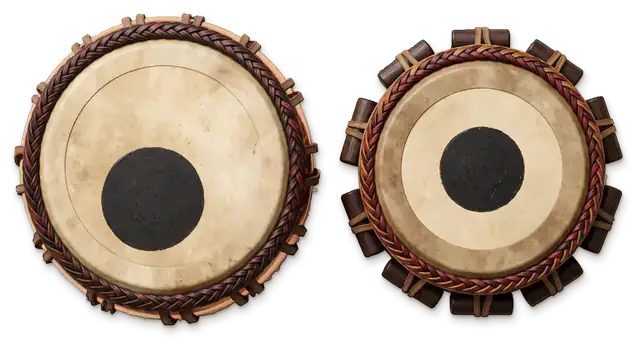
Each bol is one stroke, or two struck together: the right hand on the dayan, the smaller drum, and the left hand on the bayan, the bigger one. An open stroke lifts off so the drum rings; a closed stroke stays down, so the sound stops at once. Tap a bol to hear it and see where the fingers land on the drums.
right hand Tin (open) + left hand Ge (open)
Tin: Index finger strikes the open skin just outside the black patch and lifts; the ring and little fingers rest as for Na. A softer tone that rings longer than Na.
Ge: Middle and ring fingers strike the open skin beyond the black patch and lift, the wrist resting on the head. The bass rings.
right hand Ti (closed)
Ti: Middle and ring fingers strike the middle of the black patch and stay down. Short and dry. Inside quick runs such as TiRaKiTa and TiTa; the Ta at the end of TiRaKiTa and KiTa is the same dry stroke, often with the ring and little fingers at the edge of the patch.
left hand Ge (open)
Ge: Middle and ring fingers strike the open skin beyond the black patch and lift, the wrist resting on the head. The bass rings.
right hand Di (open)
Di: The four fingers together strike the black patch and lift at once, so the drum rings under a soft slap.
right hand Na (open)
Na: Index finger strikes the rim (kinar) and lifts; the ring and little fingers rest on the edge of the black patch. Bright and ringing, and soon gone.
Ti: right hand Ti (closed); then Ta: right hand Ra (closed)
Ti: Middle and ring fingers strike the middle of the black patch and stay down. Short and dry. Inside quick runs such as TiRaKiTa and TiTa; the Ta at the end of TiRaKiTa and KiTa is the same dry stroke, often with the ring and little fingers at the edge of the patch.
Ra: Index finger strikes the black patch and stays down. Short and dry, a little brighter than Ti.
left hand Ka (closed)
Ka: The flat hand slaps the bayan and stays down. No ring, no bass.
right hand Na (open) + left hand Ge (open)
Na: Index finger strikes the rim (kinar) and lifts; the ring and little fingers rest on the edge of the black patch. Bright and ringing, and soon gone.
Ge: Middle and ring fingers strike the open skin beyond the black patch and lift, the wrist resting on the head. The bass rings.
right hand Tun (open) + left hand Ge (open)
Tun: Index finger strikes the middle of the black patch (syahi) and lifts at once, with no finger resting. A deep, singing ring.
Ge: Middle and ring fingers strike the open skin beyond the black patch and lift, the wrist resting on the head. The bass rings.
right hand Ti (closed)
Ti: Middle and ring fingers strike the middle of the black patch and stay down. Short and dry. Inside quick runs such as TiRaKiTa and TiTa; the Ta at the end of TiRaKiTa and KiTa is the same dry stroke, often with the ring and little fingers at the edge of the patch.
Ga: left hand Ge (open); then Di: right hand Di (open)
Di: The four fingers together strike the black patch and lift at once, so the drum rings under a soft slap.
Ge: Middle and ring fingers strike the open skin beyond the black patch and lift, the wrist resting on the head. The bass rings.
Gi: left hand Ge (open); then Na: right hand Na (open)
Na: Index finger strikes the rim (kinar) and lifts; the ring and little fingers rest on the edge of the black patch. Bright and ringing, and soon gone.
Ge: Middle and ring fingers strike the open skin beyond the black patch and lift, the wrist resting on the head. The bass rings.
The nine single strokes
Right hand, on the dayan (the smaller drum)
Open. Index finger strikes the rim (kinar) and lifts; the ring and little fingers rest on the edge of the black patch. Bright and ringing, and soon gone.
Open. Index finger strikes the open skin just outside the black patch and lifts; the ring and little fingers rest as for Na. A softer tone that rings longer than Na.
Open. Index finger strikes the middle of the black patch (syahi) and lifts at once, with no finger resting. A deep, singing ring.
Open. The four fingers together strike the black patch and lift at once, so the drum rings under a soft slap.
Closed. Middle and ring fingers strike the middle of the black patch and stay down. Short and dry. Inside quick runs such as TiRaKiTa and TiTa; the Ta at the end of TiRaKiTa and KiTa is the same dry stroke, often with the ring and little fingers at the edge of the patch.
Closed. Index finger strikes the black patch and stays down. Short and dry, a little brighter than Ti.
Left hand, on the bayan (the bigger drum)
Open. Middle and ring fingers strike the open skin beyond the black patch and lift, the wrist resting on the head. The bass rings.
Open. Ge, then the heel of the hand presses forward on the head so the bass slides up in pitch. Players add this slide by choice, often on the last bass stroke before sam; a written Ghe is usually a plain Ge.
Closed. The flat hand slaps the bayan and stays down. No ring, no bass.
Count all eighteen matras aloud and give a sign on every one. Sam, marked X, is the Dhin on matra 1. Clap on matras 1, 2 and 3; wave on matra 4 (the second Ghet); clap on 5, 6 and 7; wave on 8 (Kat); then clap straight through from matra 9 to matra 17, and wave on 18, the closing Gina.
So the pattern is three claps and a wave, three claps and a wave, nine claps and a wave. The final wave on Gina is the signal that sam is next: the cycle returns to the Dhin on matra 1. Tal Prakash prints the same claps but does not mark the three waves; it simply joins each waved matra to the vibhag before it.
How each bol is played
Bol
How it is played
Dhin
both drums at once: the open right-hand Tin on the dayan with the open Ga or Gha on the bayan; ringing8,11
Dha
both drums at once: Na or Ta on the rim (chanti) of the dayan with Ga or Gha on the bayan8,11
Tet
dayan, closed: the middle finger (or middle and ring together, in the Purab style) presses into the centre of the black patch (syahi)11
Ghet
bayan, left hand: the middle and ring (or index and middle) fingers strike the open space between the syahi and the rim, then the wrist presses the drum so the sound is cut short10
Din
dayan, open: all four fingers held together strike the syahi lightly, just short of its edge, and lift at once so it rings (the same stroke as Tu or Thun)8,11
Ta
dayan, right hand: the ring finger rests at the edge of the syahi and the tip of the index finger strikes the rim; damped inside a theka, ringing when the finger lifts at once10
TiTa
dayan, two closed strokes in one matra: middle and ring fingers together press straight into the centre of the syahi, then at once the index finger presses the same spot11
Kat
bayan, closed: a flat slap of the left hand with fingers and thumb together, the heel of the hand staying on the drum; a looser slap that lets a faint Ta be heard10
Dhum
both drums, built the way Dhin is (an open right-hand stroke sounded with an open Ga or Gha on the bayan), with the open Tu, four fingers lightly on the syahi and lifted at once, as the right-hand part10,11
Kit
dayan, closed: only the tips of the four right-hand fingers fall on the syahi11
Ga
bayan, open: middle and ring fingers strike between the syahi and the rim and lift at once, so the bass rings10
Di
dayan: struck on the syahi, between the two bayan strokes of Ga Di Gi Na12
dayan: in Ga Di Gi Na, the tip of the middle finger falls on the syahi12
Lakshmi in dugun, tigun and chaugun
Layakari fits the theka more than once into one cycle. Here the whole theka is repeated, starting on sam: twice for dugun, three times for tigun and four times for chaugun. Bols under one arc share a matra. Play keeps the matra at the tempo set at the top of the page, so the bols come two, three or four times as fast.
Lakshmi dugun (दुगुन): two bols in every matra
80 a minute
1Dhin Tetधिं तेत्×sam
2Ghet Ghetघेत् घेत्2tali
3Din Taदिं ता3tali
4Ti Ta Katतिट कत0khali
5Dha Dinधा दिं4tali
6Ta Dhumता धुम5tali
7Kit Dhumकिट धुम6tali
8Kit Katकिट क्त0khali
9Ga Di Gi Naगदि गिन7tali
10Dhin Tetधिं तेत्8tali
11Ghet Ghetघेत् घेत्9tali
12Din Taदिं ता10tali
13Ti Ta Katतिट कत11tali
14Dha Dinधा दिं12tali
15Ta Dhumता धुम13tali
16Kit Dhumकिट धुम14tali
17Kit Katकिट क्त15tali
18Ga Di Gi Naगदि गिन0khali
Lakshmi tigun (तिगुन): three bols in every matra
80 a minute
1Dhin Tet Ghetधिं तेत् घेत्×sam
2Ghet Din Taघेत् दिं ता2tali
3Ti Ta Kat Dhaतिट कत धा3tali
4Din Ta Dhumदिं ता धुम0khali
5Kit Dhum Kitकिट धुम किट4tali
6Kat Ga Di Gi Naक्त गदि गिन5tali
7Dhin Tet Ghetधिं तेत् घेत्6tali
8Ghet Din Taघेत् दिं ता0khali
9Ti Ta Kat Dhaतिट कत धा7tali
10Din Ta Dhumदिं ता धुम8tali
11Kit Dhum Kitकिट धुम किट9tali
12Kat Ga Di Gi Naक्त गदि गिन10tali
13Dhin Tet Ghetधिं तेत् घेत्11tali
14Ghet Din Taघेत् दिं ता12tali
15Ti Ta Kat Dhaतिट कत धा13tali
16Din Ta Dhumदिं ता धुम14tali
17Kit Dhum Kitकिट धुम किट15tali
18Kat Ga Di Gi Naक्त गदि गिन0khali
Lakshmi chaugun (चौगुन): four bols in every matra
80 a minute
1Dhin Tet Ghet Ghetधिं तेत् घेत् घेत्×sam
2Din Ta Ti Ta Katदिं ता तिट कत2tali
3Dha Din Ta Dhumधा दिं ता धुम3tali
4Kit Dhum Kit Katकिट धुम किट क्त0khali
5Ga Di Gi Na Dhin Tetगदि गिन धिं तेत्4tali
6Ghet Ghet Din Taघेत् घेत् दिं ता5tali
7Ti Ta Kat Dha Dinतिट कत धा दिं6tali
8Ta Dhum Kit Dhumता धुम किट धुम0khali
9Kit Kat Ga Di Gi Naकिट क्त गदि गिन7tali
10Dhin Tet Ghet Ghetधिं तेत् घेत् घेत्8tali
11Din Ta Ti Ta Katदिं ता तिट कत9tali
12Dha Din Ta Dhumधा दिं ता धुम10tali
13Kit Dhum Kit Katकिट धुम किट क्त11tali
14Ga Di Gi Na Dhin Tetगदि गिन धिं तेत्12tali
15Ghet Ghet Din Taघेत् घेत् दिं ता13tali
16Ti Ta Kat Dha Dinतिट कत धा दिं14tali
17Ta Dhum Kit Dhumता धुम किट धुम15tali
18Kit Kat Ga Di Gi Naकिट क्त गदि गिन0khali
About Lakshmi
Lakshmi taal is a rare cycle of eighteen matras that belongs to the pakhawaj. What makes it stand out is its clapping: in the Sangeet Visharad layout each of the eighteen matras is a vibhag of its own, so the hand gives a sign on every single count. Fifteen of those signs are claps and three are waves.
The theka opens on the ringing Dhin at sam, runs through the damped syllables Tet and Ghet, and then works through pakhawaj phrases such as Dhum Kit, twice, before the familiar closing cadence Kat Gadi Gina that leads back to sam. Tal Prakash places Lakshmi in its chapter of eighteen-matra pakhawaj taals, alongside Matta, Ganesh and Basant, and counts it in the sankirna jati, the family built on a nine-based laya.
Its pakhawaj phrases sit naturally on that drum, but the same eighteen counts can carry tabla bols too, and one tabla manual prints a separate tabla theka for it. The books do not agree on its bols, and one older text gives it a quite different length; those versions are set out under disagreements below.
tabla, which has its own theka for it and can borrow tabla prakars
Where teachers and books differ
vibhags: Sangeet Visharad prints eighteen one-matra vibhags with waves on 4, 8 and 18. Tal Prakash (p. 110) prints fifteen vibhags with claps on the same fifteen matras and no wave signs: matras 4, 8 and 18 are folded into the vibhag before them.1,2
theka: The books give different bols. Sangeet Visharad: Dhin Tet Ghet Ghet Din Ta Tit Kat Dha Din Ta Dhum Kit Dhum Kit Kat Gadi Gina. Tal Prakash: a tirakita-based theka beginning Dhinna Dhidha (shown under variations). The Art of Tabla Playing gives a pakhawaj theka beginning Dha - Dhet Dhet, with Dhet where Sangeet Visharad has Ghet, and a separate tabla theka beginning Dha - Dhin Dhin Dha.1,2,6,7
marks: The Art of Tabla Playing calls Lakshmi a pakhawaj taal with claps falling on fractions of a beat; its pakhawaj theka carries 21 hand signs in 18 beats, and its tabla theka is headed 15 claps and 3 waves but places a wave on beat 2.6,7
matras: Eighteen matras is the length in Sangeet Visharad, Tal Prakash and The Art of Tabla Playing. Tal Prakash adds a 36-matra 'other form', and the Chandrakantha glossary gives 18 or 36 beats. Ma'arif-un-Naghmat, listing the talas of the old Sangeet Makarand, gives Lakshmi tala 41 matras and adds that opinions on this tala differ.2,5,9
Bhagwat Sharan Sharma's version: eighteen matras in fifteen vibhags, all marked with claps (sam and talis 2 to 15). The matras that carry a wave in Sangeet Visharad (4, 8 and 18) have no sign of their own here.2
Taals similar to Lakshmi, and how to tell them apart
Both have 18 matras and both are pakhawaj taals of the sankirna jati. Matta is counted in nine vibhags of two matras each, with six claps (matras 1, 5, 7, 11, 13, 15) and waves on 3, 9 and 17; its theka is Dha - Dhi Da Na Ka Dhi Da Na Ka Ti Ta Ka Ta Ga Di Gi Na. Lakshmi gives a sign on every matra: eighteen one-matra vibhags, fifteen claps and waves on 4, 8 and 18. Both cycles close on the Ga Di Gi Na cadence.1,3,4,13
Common mistakes when learning Lakshmi
Grouping the matras in twos or threes out of habit: in the Sangeet Visharad layout every matra gets its own clap or wave.
Putting the waves on 3, 9 and 17 as in Matta; in Lakshmi the waves fall on matras 4, 8 and 18.
Treating the last wave on Gina as the end of the cycle: the cycle ends on matra 18, but sam is the Dhin that follows.
Mixing the Sangeet Visharad theka with the Tal Prakash one: they share the length and the claps, not the bols.
Questions about Lakshmi
Lakshmi taal mein kitni matraen hoti hain?
Lakshmi taal mein 18 matraen hoti hain. Tal Prakash ek 36-matra prakar bhi deta hai, par aam roop 18 matra ka hai.
Lakshmi taal mein kitne vibhag, tali aur khali hain?
Sangeet Visharad ke anusaar 18 vibhag hain, har matra ek vibhag. Inmein 15 tali (sam sahit) aur 3 khali hain.
Lakshmi taal mein khali kis matra par hai?
Khali matra 4, 8 aur 18 par hai. Sam matra 1 par hai, aur baaki sab matraon par tali padti hai.
Lakshmi taal ka theka kya hai?
Sangeet Visharad ka theka hai: Dhin Tet Ghet Ghet Din Ta Tit Kat Dha Din Ta Dhum Kit Dhum Kit Kat Gadi Gina, har matra par ek bol.
Lakshmi taal aur Matta taal mein antar kya hai?
Dono 18 matra ki pakhawaj taalein hain. Matta mein 2-2 matra ke 9 vibhag hain (6 tali, khali matra 3, 9 aur 17 par), jabki Lakshmi mein har matra alag vibhag hai (15 tali, khali matra 4, 8 aur 18 par). Dono ke bol bhi alag hain, bas ant mein dono Ga Di Gi Na par lautti hain.
Lakshmi taal kis vadya ki taal hai?
Yeh pakhawaj ki taal hai. Tal Prakash ke anusaar tabla ke prakar bhi isme bajaye ja sakte hain, aur The Art of Tabla Playing iska alag tabla theka deta hai.
Lakshmi taal ki jati kya hai?
Tal Prakash ise Matta ke saath sankirna jati mein rakhta hai, yani nau par aadharit laya wali taal.