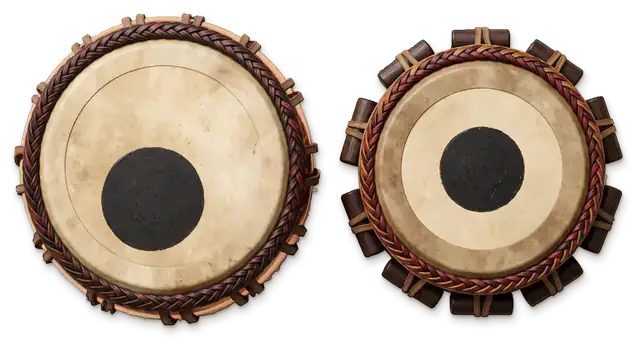
A rare 22-matra pakhawaj taal in eight vibhags (4+2+4+2+4+2+2+2), every one a clap with no khali; heard in pakhawaj parans, kathak and tabla solos.
Also written: Ashta Mangal, Ashtmangal, Asht Mangal
Matras
22
Vibhags
8 (4 + 2 + 4 + 2 + 4 + 2 + 2 + 2)
Tali on matra
1, 5, 7, 11, 13, 17, 19, 21
Khali on matra
None
× is sam, the first beat, where you clap. A number is another clap (tali); 0 is khali, where you wave the hand instead. Set Tabla Sa to the Sa of your harmonium or tanpura to practise along.
Needs more sources: the theka on this page rests on a single source.
Ashtamangal theka
80 a minute
Bayan · leftGeDhaDayan · rightNa
Dha: right hand Na and left hand Ge
1Dhaधा×sam
2ऽऽ
3Kiकि
4Taट
5Taत2tali
6Kaक
7Dhuधु3tali
8Maम
9Kiकि
10Taट
11Taत4tali
12Kaक
13Dheधे5tali
14ऽऽ
15Ttaत्ता
16ऽऽ
17Taत6tali
18Kaक
19Dhaध7tali
20Diदि
21Giगि8tali
22Naन
Play the tabla
Left hand
Right hand
Bols
Ashtamangal theka (bol)
The theka is the basic pattern of tabla bols that marks out one cycle of the taal. Play it at the top of the page and follow the beat.1(needs more sources)
Bols in English letters
Dha - Ki Ta | Ta Ka | Dhu Ma Ki Ta | Ta Ka | Dhe - Tta - | Ta Ka | Dha Di | Gi Na
Bols in Hindi (Devanagari)
धा ऽ कि ट | त क | धु म कि ट | त क | धे ऽ त्ता ऽ | त क | ध दि | गि न
How to play the strokes of Ashtamangal
Each bol is one stroke, or two struck together: the right hand on the dayan, the smaller drum, and the left hand on the bayan, the bigger one. An open stroke lifts off so the drum rings; a closed stroke stays down, so the sound stops at once. Tap a bol to hear it and see where the fingers land on the drums.
right hand Na (open) + left hand Ge (open)
Na: Index finger strikes the rim (kinar) and lifts; the ring and little fingers rest on the edge of the black patch. Bright and ringing, and soon gone.
Ge: Middle and ring fingers strike the open skin beyond the black patch and lift, the wrist resting on the head. The bass rings.
left hand Ka (closed)
Ka: The flat hand slaps the bayan and stays down. No ring, no bass.
right hand Na (open)
Na: Index finger strikes the rim (kinar) and lifts; the ring and little fingers rest on the edge of the black patch. Bright and ringing, and soon gone.
left hand Ka (closed)
Ka: The flat hand slaps the bayan and stays down. No ring, no bass.
right hand Tun (open) + left hand Ge (open)
Tun: Index finger strikes the middle of the black patch (syahi) and lifts at once, with no finger resting. A deep, singing ring.
Ge: Middle and ring fingers strike the open skin beyond the black patch and lift, the wrist resting on the head. The bass rings.
left hand Ge (open)
Ge: Middle and ring fingers strike the open skin beyond the black patch and lift, the wrist resting on the head. The bass rings.
right hand Ti (closed) + left hand Ge (open)
Ti: Middle and ring fingers strike the middle of the black patch and stay down. Short and dry. Inside quick runs such as TiRaKiTa and TiTa; the Ta at the end of TiRaKiTa and KiTa is the same dry stroke, often with the ring and little fingers at the edge of the patch.
Ge: Middle and ring fingers strike the open skin beyond the black patch and lift, the wrist resting on the head. The bass rings.
right hand Na (open)
Na: Index finger strikes the rim (kinar) and lifts; the ring and little fingers rest on the edge of the black patch. Bright and ringing, and soon gone.
right hand Di (open)
Di: The four fingers together strike the black patch and lift at once, so the drum rings under a soft slap.
left hand Ge (open)
Ge: Middle and ring fingers strike the open skin beyond the black patch and lift, the wrist resting on the head. The bass rings.
right hand Na (open)
Na: Index finger strikes the rim (kinar) and lifts; the ring and little fingers rest on the edge of the black patch. Bright and ringing, and soon gone.
The nine single strokes
Right hand, on the dayan (the smaller drum)
Open. Index finger strikes the rim (kinar) and lifts; the ring and little fingers rest on the edge of the black patch. Bright and ringing, and soon gone.
Open. Index finger strikes the open skin just outside the black patch and lifts; the ring and little fingers rest as for Na. A softer tone that rings longer than Na.
Open. Index finger strikes the middle of the black patch (syahi) and lifts at once, with no finger resting. A deep, singing ring.
Open. The four fingers together strike the black patch and lift at once, so the drum rings under a soft slap.
Closed. Middle and ring fingers strike the middle of the black patch and stay down. Short and dry. Inside quick runs such as TiRaKiTa and TiTa; the Ta at the end of TiRaKiTa and KiTa is the same dry stroke, often with the ring and little fingers at the edge of the patch.
Closed. Index finger strikes the black patch and stays down. Short and dry, a little brighter than Ti.
Left hand, on the bayan (the bigger drum)
Open. Middle and ring fingers strike the open skin beyond the black patch and lift, the wrist resting on the head. The bass rings.
Open. Ge, then the heel of the hand presses forward on the head so the bass slides up in pitch. Players add this slide by choice, often on the last bass stroke before sam; a written Ghe is usually a plain Ge.
Closed. The flat hand slaps the bayan and stays down. No ring, no bass.
Mixed: three vibhags of four matras (laghu) and five of two matras (drut)2
How to count Ashtamangal
Clap on matras 1, 5, 7, 11, 13, 17, 19 and 21. That is eight claps in one cycle and no wave, so every vibhag is a tali; the first clap is sam. The long vibhags of four matras come first and alternate with short ones of two (4, 2, 4, 2, 4, 2), and the cycle ends with three short vibhags of two matras in a row (Ta Ka, Dha Di, Gi Na), which lead quickly back to sam.
It helps to hear the theka in pairs of matras: Dha-, KiTa, TaKa, DhuMa, KiTa, TaKa, Dhe-, Tta-, TaKa, DhaDi, GiNa. The landmarks are the open Dha on sam, the Dhumakita at matra 7 and the open Dhe at matra 13; the Dhadi Gina at the end is the last thing heard before sam returns.
How each bol is played
Bol
How it is played
Dha
both drums: the mridang Ta on the right (flat hand, fingers together, struck with the little-finger side of the palm a little above the middle of the syahi and drawn away slowly) together with the open Gha on the left; ringing7,8
Ki
right drum, closed: the ring and middle fingers strike the syahi together and stay pressed down, so the sound is damped7
Ta
right drum: in KiTa it is closed, struck with the index finger near the Ki spot while the ring and middle fingers lift; in TaKa it goes with the closed left-hand Ka, and Tal Prakash describes the right-hand part both as a closed stroke like Ki and as a flat-hand thap7,8
Ka
left drum, closed: the left-hand Kat, a flat hand with all the fingers struck on the middle of the dough patch and held down; damped7,8
Dhu
a pakhawaj bol, the opening of Dhumakita: Tal Prakash warns that Dhumakita in its true form cannot be produced on the tabla, so tabla players can only imitate it9
Ma
the second syllable of the pakhawaj phrase Dhumakita (Dhu Ma Ki Ta), which Tal Prakash says cannot be played in its true form on the tabla9
Dhe
both drums, made the same way as Dha (right-hand Ta with the open left-hand Gha); ringing8
Tta
right drum: the open mridang Ta, flat hand struck with the little-finger side of the palm above the middle of the syahi; ringing7
Di
right drum: the four fingers strike the middle of the syahi and lift at once, so it rings; in Gadi the right palm strikes and lifts at once7,8
Gi
left drum, open: struck like the open Gha (flat left palm, half the palm on the head just above the dough patch, lifted at once); ringing7,8
Na
right drum: in the closing Gina all the right-hand fingers strike together in the middle of the head, as in Tal Prakash's Gan, right after the open left-hand Gi8
Ashtamangal in dugun, tigun and chaugun
Layakari fits the theka more than once into one cycle. Here the whole theka is repeated, starting on sam: twice for dugun, three times for tigun and four times for chaugun. Bols under one arc share a matra. Play keeps the matra at the tempo set at the top of the page, so the bols come two, three or four times as fast.
Ashtamangal dugun (दुगुन): two bols in every matra
80 a minute
1Dha ऽधा ऽ×sam
2Ki Taकि ट
3Ta Kaत क
4Dhu Maधु म
5Ki Taकि ट2tali
6Ta Kaत क
7Dhe ऽधे ऽ3tali
8Tta ऽत्ता ऽ
9Ta Kaत क
10Dha Diध दि
11Gi Naगि न4tali
12Dha ऽधा ऽ
13Ki Taकि ट5tali
14Ta Kaत क
15Dhu Maधु म
16Ki Taकि ट
17Ta Kaत क6tali
18Dhe ऽधे ऽ
19Tta ऽत्ता ऽ7tali
20Ta Kaत क
21Dha Diध दि8tali
22Gi Naगि न
Ashtamangal tigun (तिगुन): three bols in every matra
80 a minute
1Dha ऽ Kiधा ऽ कि×sam
2Ta Ta Kaट त क
3Dhu Ma Kiधु म कि
4Ta Ta Kaट त क
5Dhe ऽ Ttaधे ऽ त्ता2tali
6ऽ Ta Kaऽ त क
7Dha Di Giध दि गि3tali
8Na Dha ऽन धा ऽ
9Ki Ta Taकि ट त
10Ka Dhu Maक धु म
11Ki Ta Taकि ट त4tali
12Ka Dhe ऽक धे ऽ
13Tta ऽ Taत्ता ऽ त5tali
14Ka Dha Diक ध दि
15Gi Na Dhaगि न धा
16ऽ Ki Taऽ कि ट
17Ta Ka Dhuत क धु6tali
18Ma Ki Taम कि ट
19Ta Ka Dheत क धे7tali
20ऽ Tta ऽऽ त्ता ऽ
21Ta Ka Dhaत क ध8tali
22Di Gi Naदि गि न
Ashtamangal chaugun (चौगुन): four bols in every matra
80 a minute
1Dha ऽ Ki Taधा ऽ कि ट×sam
2Ta Ka Dhu Maत क धु म
3Ki Ta Ta Kaकि ट त क
4Dhe ऽ Tta ऽधे ऽ त्ता ऽ
5Ta Ka Dha Diत क ध दि2tali
6Gi Na Dha ऽगि न धा ऽ
7Ki Ta Ta Kaकि ट त क3tali
8Dhu Ma Ki Taधु म कि ट
9Ta Ka Dhe ऽत क धे ऽ
10Tta ऽ Ta Kaत्ता ऽ त क
11Dha Di Gi Naध दि गि न4tali
12Dha ऽ Ki Taधा ऽ कि ट
13Ta Ka Dhu Maत क धु म5tali
14Ki Ta Ta Kaकि ट त क
15Dhe ऽ Tta ऽधे ऽ त्ता ऽ
16Ta Ka Dha Diत क ध दि
17Gi Na Dha ऽगि न धा ऽ6tali
18Ki Ta Ta Kaकि ट त क
19Dhu Ma Ki Taधु म कि ट7tali
20Ta Ka Dhe ऽत क धे ऽ
21Tta ऽ Ta Kaत्ता ऽ त क8tali
22Dha Di Gi Naध दि गि न
About Ashtamangal
Ashtamangal is a long, uneven cycle from the pakhawaj repertoire. Bhagwat Sharan Sharma's Tal Prakash (1963) gives it 22 matras split into eight vibhags of 4, 2, 4, 2, 4, 2, 2 and 2 matras, and marks every vibhag with a clap: there is no khali anywhere in the cycle. The bols are mridang bols, such as Dhumakita, Dhe and the closing Dhadi Gina.
The same 22-matra frame appears in two older books. Ma'arif-un-Naghmat lists Ashtamangal among the taals of the old texts and writes it in anga signs as laghu, drut, laghu, drut, laghu, drut, drut, drut, which adds up to 22. Mridang Sagar prints pakhawaj parans in it at three and four times the speed, and the clap counts it gives for the tigun parans land exactly on Tal Prakash's vibhag lines.
Today the taal is a rarity. The tabla player and scholar Aneesh Pradhan notes that it is heard more on the pakhawaj than on the tabla and that kathak dancers often use it, though he counts it as an 11-matra taal.
Ashtamangal belongs to the old stock of taals named in the texts: Ma'arif-un-Naghmat gives it in its table of the treatises' taals with its anga signs and 22 matras. The pakhawaj tradition kept it in use, and Mridang Sagar prints parans for it in tigun (66 counts to one cycle) and chaugun (88 counts). In the second part of Tal Parichay, Girish Chandra Srivastava names Ashtamangal with Dhamar and Jhoomra as taals often heard in tabla solo programmes, and complains that tabla soloists give too little thought to choosing suitable taals, now that the tabla's style stands clearly apart from the pakhawaj's.
Where teachers and books differ
matras: Tal Prakash (p. 86), Ma'arif-un-Naghmat (p. 360) and Mridang Sagar (p. 189, by its tigun and chaugun parans of 66 and 88 counts) all give 22 matras. Aneesh Pradhan, writing on Scroll.in, calls Ashtamangal an 11-matra taal like Rudra and close to Char taal ki sawari. Read two matras at a time, the 22-matra theka of Tal Prakash is eleven bols long, the same eleven that Mridang Sagar spreads over 22 matras for Chakra Manth.1,2,3,5
marks: Tal Prakash numbers all eight vibhags as talis (X, 2 to 8) and shows no khali; Mridang Sagar likewise lists only clap positions. Ma'arif-un-Naghmat gives the anga signs (laghu and drut) without saying where a khali would fall.1,2,3
strokes: The theka is made of mridang bols. Tal Prakash describes them as played on the pakhawaj and warns that Dhumakita cannot be played in its true form on the tabla, so a tabla version of this theka is an adaptation.7,9
Taals similar to Ashtamangal, and how to tell them apart
Chakra Manth
Mridang Sagar gives this 22-matra taal in seven parts (laghu, laghu, drut, laghu, laghu, drut, drut: 4+4+2+4+4+2+2) with the same eleven bols spread one to every two matras. It says Ashtamangal's parans in aad, tigun and chaugun all fit it, since the two have the same weight and differ only in where the claps fall.4,5
Aneesh Pradhan pairs Rudra with Ashtamangal as 11-matra taals heard mostly on the pakhawaj; the older books give Ashtamangal 22 matras in eight vibhags.1,6
Char taal ki sawari
An 11-matra taal; Aneesh Pradhan says Ashtamangal is close to it both in structure and in the syllables of its theka.6
Common mistakes when learning Ashtamangal
Waving a khali: in Tal Prakash's version all eight vibhags are claps, so the hand never waves.
Splitting the 22 matras into two equal halves of 11; the vibhags are uneven (4, 2, 4, 2, 4, 2, 2, 2).
Losing count in the last six matras: three two-matra vibhags in a row (Ta Ka, Dha Di, Gi Na) end the cycle, and each one gets its own clap.
Assuming every source means the same cycle: the older books count 22 matras, while Aneesh Pradhan describes an 11-matra Ashtamangal, so check which one a teacher or dancer is using.
Playing the pakhawaj bol Dhumakita on the tabla as if it sounded the same; Tal Prakash says its true form cannot be made on the tabla.
Questions about Ashtamangal
Ashtamangal taal mein kitni matraen hoti hain?
Tal Prakash, Ma'arif-un-Naghmat and Mridang Sagar all give Ashtamangal 22 matras. Aneesh Pradhan describes it as an 11-matra taal.
Ashtamangal taal ke vibhag kitne hain?
Eight vibhags of 4, 2, 4, 2, 4, 2, 2 and 2 matras. In the old anga signs that is laghu, drut, laghu, drut, laghu, drut, drut, drut.
Ashtamangal mein khali kis matra par hai?
There is no khali. Tal Prakash marks all eight vibhags as talis, on matras 1 (sam), 5, 7, 11, 13, 17, 19 and 21.
Ashtamangal taal ka theka kya hai?
Tal Prakash gives: धा ऽ कि ट | त क | धु म कि ट | त क | धे ऽ त्ता ऽ | त क | ध दि | गि न, with sam on the first Dha.
Ashtamangal tabla par bajta hai ya pakhawaj par?
It is a pakhawaj taal at heart and is heard more on the pakhawaj; kathak dancers also use it. Tabla players have played it in solo recitals, though its bols such as Dhumakita belong to the pakhawaj.
Ashtamangal ki tigun aur chaugun kaise hoti hai?
Mridang Sagar's tigun parans fit 66 counts into one cycle, with the claps on counts 1, 13, 19, 31, 37, 49, 55 and 61; its chaugun parans take 88 counts.
Ashtamangal aur Chakra Manth mein antar kya hai?
Both have 22 matras and, by Mridang Sagar, the same weight, so the same parans fit both. Ashtamangal has eight vibhags, while Chakra Manth has seven (4+4+2+4+4+2+2), so the claps fall in different places.
Sources and further learning
The numbers in the text point to these sources.
Bhagwat Sharan Sharma (ed. Lakshmi Narayan Garg). Tal Prakash. Sangeet Karyalaya, Hathras, 1963, p. 86.