
Drums · Avanaddha · Pair of drums
Tabla तबला
Also called tabla-bayan, dayan and bayan
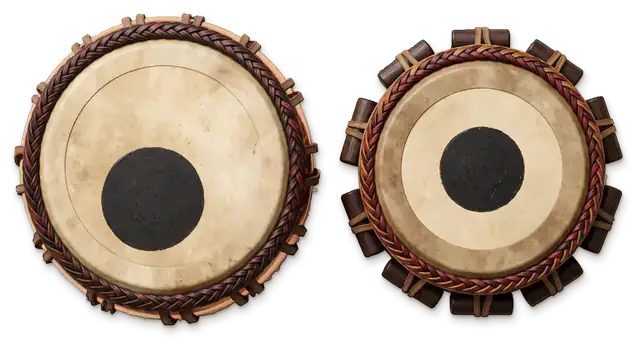
The tabla is a pair of hand drums, a small wooden one tuned to the music's Sa and a larger metal one for the bass, played with the fingers and the palms.1,2
Play the tabla: Teentaal theka
Dha: right hand Na and left hand Ge
1Dhaधाsam
2Dhinधिं
3Dhinधिं
4Dhaधा
5Dhaधाtali
6Dhinधिं
7Dhinधिं
8Dhaधा
9Dhaधाkhali
10Tinतिं
11Tinतिं
12Taता
13Taताtali
14Dhinधिं
15Dhinधिं
16Dhaधा
Play the tabla
- Class
- Drums (Avanaddha)
- Sound
- Two hand drums, each with a black tuning patch on its skin
- Region
- North India, Pakistan and Bangladesh
- Tradition
- Hindustani
Learn to play the tabla
Parts of the tabla
The right-hand drum, the dayan (properly called the tabla), is a block of wood, usually teak or rosewood, hollowed out about halfway down, roughly 15 cm across and 25 cm high. The left-hand drum, the bayan or dagga, is wider and shaped like a kettledrum, most often of brass, sometimes of copper, steel or clay.1,2
Each skin (puri) has a black patch in the middle, the syahi, built up from many layers of a paste of starch and a black powder. It gives the tabla its clear, bell-like pitch. The skin is laced to the shell with a leather strap (baddhi), and on the dayan the strap runs over eight wooden blocks (gatta) that tighten or loosen it.1,2
While playing, each drum sits on a padded cloth ring, the chutta or guddi, and the player sits cross-legged on the floor.1
How the tabla is tuned
The dayan is tuned to the Sa of the singer or soloist, and sometimes to Pa or Ma. The bayan sits roughly a fifth to an octave lower; its pitch is not fixed, because the player presses the heel of the hand into the skin to bend it while playing.1,2
Tuning starts with the gatta: knocking a block down raises the pitch, knocking it up lowers it. Fine adjustment is made by tapping the braided rim (gajra) with a small hammer, striking the drum with the right hand while the left holds the hammer.1,2
How the tabla is held and played
Every pattern is spoken as well as played, in syllables called bols. Varma teaches ten basic syllables: Ta or Na, Ti or Tin, Din or Thun, Tun, Te and Re on the right drum; Ghe and Ke on the left; and Dha and Dhin, which use both hands.2
Dha is Na on the right drum struck together with Ghe on the left; Dhin is Tin with Ghe. Some strokes ring, such as Tin, Tun and Ghe; others are stopped dead, such as Te, Ti and Ke.1
Varma asks for an upright back, the right wrist held above the drum and the elbows free, and for slow, regular practice while counting the beats.2
The tabla in the music
The tabla accompanies almost every Hindustani form except alap and dhrupad, which use the pakhawaj. It is also a solo instrument, with a harmonium or sarangi accompanying it.3
Solo playing develops a theme by strict rules, as in the kayda, a composition that may only use the bols of its opening phrase. Light forms like dadra and keherwa take fast fills called laggis instead.1
History of the tabla
Its origin is disputed. Drum pairs appear in 2nd-century BCE carvings at the Bhaja caves, and the Natya Shastra describes paste patches like the syahi; but clear pictures of the tabla itself appear only from about 1745. One story says Amir Khusrau cut a drum in half to make it, but nothing from his time supports this. Another tells of an 18th-century musician, also called Amir Khusru, cutting a pakhawaj in two; scholars give this no credence.1,3
Players pass on their styles through gharanas. The Delhi gharana, from the early 18th century, is held to be the oldest; others include Lucknow, Ajrada, Farukhabad, Benares and Punjab.1
Players who made the tabla known
Tabla lessons
Short lessons, one skill each, in order. Each one ends with something to practise.
Questions about the tabla
Which drum is the tabla, and which is the bayan?
Strictly, the tabla is the smaller wooden drum played with the right hand (also called dayan); the larger metal drum for the left hand is the bayan or dagga. Together they are usually just called the tabla.1
Sources and further reading
The numbers in the text point to these sources. Where they disagree, the text says so.
- Wikipedia contributors. Tabla. Wikipedia.
- Sudhir Kumar Varma. The Art of Tabla Playing. Lucknow, 1999, p. 11–13.
- Bimalakanta Roychaudhuri. The Dictionary of Hindustani Classical Music. Motilal Banarsidass, Delhi, 2000, p. 182 ("Tabla").