
Ada Chautaal
Ada Chautaal has 14 matras, one more than Jai taal. The Jai theka Zakir Hussain plays sounds close to the Ada Chautaal theka, which makes the two easy to confuse.3
Taal · 13 matras
Jai taal has 13 matras in 7 vibhags (2,2,2,2,2,1,2): sam on 1, claps on 3, 7, 11 and 12, waves on 5 and 9. A rare taal heard mostly in tabla solos.
Also written: Jai Taal, Jay Taal, Jai Tal
× is sam, the first beat, where you clap. A number is another clap (tali); 0 is khali, where you wave the hand instead. Set Tabla Sa to the Sa of your harmonium or tanpura to practise along.
Needs more sources: the theka, vibhags and tali and khali marks on this page rest on a single source.
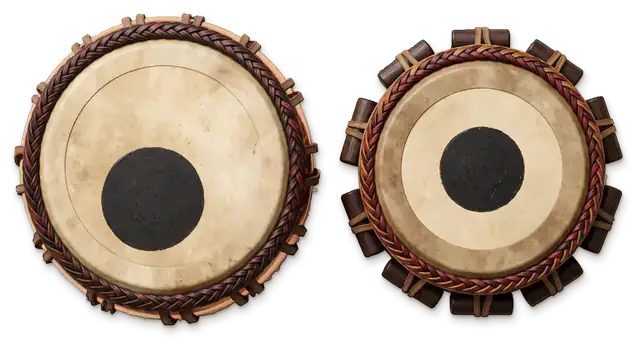
Dhin: right hand Tin and left hand Ge
Play the tabla
The theka is the basic pattern of tabla bols that marks out one cycle of the taal. Play it at the top of the page and follow the beat.1(needs more sources)
Each bol is one stroke, or two struck together: the right hand on the dayan, the smaller drum, and the left hand on the bayan, the bigger one. An open stroke lifts off so the drum rings; a closed stroke stays down, so the sound stops at once. Tap a bol to hear it and see where the fingers land on the drums.
right hand Tin (open) + left hand Ge (open)
Ti: right hand Ti (closed); then Ra: right hand Ra (closed); then Ki: left hand Ka (closed); then Ta: right hand Ti (closed)
right hand Na (open)
right hand Tin (open)
Open. Index finger strikes the rim (kinar) and lifts; the ring and little fingers rest on the edge of the black patch. Bright and ringing, and soon gone.
Open. Index finger strikes the open skin just outside the black patch and lifts; the ring and little fingers rest as for Na. A softer tone that rings longer than Na.
Open. Index finger strikes the middle of the black patch (syahi) and lifts at once, with no finger resting. A deep, singing ring.
Open. The four fingers together strike the black patch and lift at once, so the drum rings under a soft slap.
Closed. Middle and ring fingers strike the middle of the black patch and stay down. Short and dry. Inside quick runs such as TiRaKiTa and TiTa; the Ta at the end of TiRaKiTa and KiTa is the same dry stroke, often with the ring and little fingers at the edge of the patch.
Closed. Index finger strikes the black patch and stays down. Short and dry, a little brighter than Ti.
Open. Middle and ring fingers strike the open skin beyond the black patch and lift, the wrist resting on the head. The bass rings.
Open. Ge, then the heel of the hand presses forward on the head so the bass slides up in pitch. Players add this slide by choice, often on the last bass stroke before sam; a written Ghe is usually a plain Ge.
Closed. The flat hand slaps the bayan and stays down. No ring, no bass.
Clap on matra 1 (sam), clap on 3, wave on 5, clap on 7, wave on 9, clap on 11 and clap again on 12. Matra 11 stands alone as a one-matra vibhag, so the last two claps come back to back; matras 12 and 13 close the cycle.
On the tabla, the first khali (matra 5) is a silent matra followed by TiRaKiTa, with no ringing bayan stroke, and the second khali (matra 9) is Tin, the open right-hand stroke without the bayan. Sam returns on Dhin with TiRaKiTa right after it, so a listener finds it by the full, bass-heavy Dhin that follows the closing Dhin Na.
| Bol | How it is played |
|---|---|
| Dhin | Both drums together: the open, ringing right-hand stroke tin on the dayan sounds with an open Ga or Gha on the bayan.6 |
| TiRaKiTa | Four strokes in one matra: Ti with the middle finger (in the Purab style the middle and ring fingers together) pressed into the middle of the dayan's black patch, damped; Ra with the index finger pressed on the same spot, damped; Ki a closed, flat stroke on the bayan; Ta played like Ti.5,6 |
| Na | Dayan only: the ring finger rests on the edge of the black patch while the tip of the index finger strikes the rim (chanti); in a theka it is played damped.5 |
| Tin | Dayan only: with the ring finger resting on the edge of the black patch, the index finger strikes the open band of skin just outside the patch and lifts at once, so the stroke rings; it is the right-hand half of Dhin, here without the bayan.5,6 |
Layakari fits the theka more than once into one cycle. Here the whole theka is repeated, starting on sam: twice for dugun, three times for tigun and four times for chaugun. Bols under one arc share a matra. Play keeps the matra at the tempo set at the top of the page, so the bols come two, three or four times as fast.
Jai taal (also written Jay taal) is a rare Hindustani taal of 13 matras. It is an odd, uneven cycle: six of its seven vibhags hold two matras each and one holds a single matra, so the hand marks fall every two matras until the lone matra 11 breaks the pattern just before the cycle ends.
The theka shown above is built from a handful of plain tabla bols: Dhin, TiRaKiTa, Na and Tin. The fifth matra, which opens the first khali, is left empty, and the second khali on matra 9 is marked by Tin Na, played without the bayan, in place of Dhin. The cycle closes on Dhin | Dhin Na, which leads straight back to sam.
Jai taal is heard far more in tabla solos than as a frame for singing or playing. A recorded performance by Zakir Hussain, with Sultan Khan on the sarangi, explores it, and so does one by Talib Hussain of Pakistan, who also played the pakhawaj. Musicians do not agree on how the 13 matras are split or on a single fixed theka: Zakir Hussain's theka, for one, is close to that of Ada Chautaal and suggests groups of 2+2+2+2+2+3.
Ada Chautaal has 14 matras, one more than Jai taal. The Jai theka Zakir Hussain plays sounds close to the Ada Chautaal theka, which makes the two easy to confuse.3
Raas is another 13-beat cycle, but with a simpler structure than Jai taal.2
Vishwa taal also has 13 matras but is a very different cycle; the pakhawaj player Arjun Shejwal plays two forms of it.3
Jai taal has 13 matras, divided into 7 vibhags of 2, 2, 2, 2, 2, 1 and 2 matras.
Sam is on matra 1, the other claps (tali) on 3, 7, 11 and 12, and the khali waves on 5 and 9.
Dhin TiRaKiTa | Dhin Na | - TiRaKiTa | Dhin Na | Tin Na | Dhin | Dhin Na, where the dash on matra 5 is an empty matra.
Jai taal has 13 matras and Ada Chautaal has 14. Zakir Hussain's Jai theka sounds close to Ada Chautaal, but the cycle is one matra shorter.
Both have 13 beats, but Raas has a simpler structure, while Jai taal is grouped 2, 2, 2, 2, 2, 1, 2 with two khalis.
It is heard mainly in tabla solos and is seldom used to accompany singing or instruments.
It is usually played in madhya laya, a medium tempo.
The numbers in the text point to these sources.
Last updated 20 November 2026.