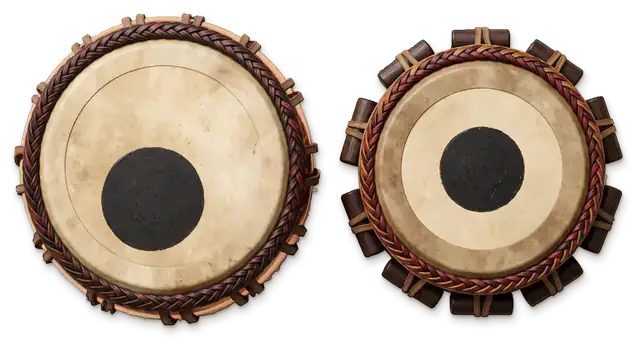
A rare 15-matra pakhawaj taal in 4 vibhags (4+4+3+4): sam on 1, claps on 5 and 12, wave on 9. Linked with dhrupad-dhamar, also played on tabla.
Also written: Gaj Jhampa, Gajjhampa Taal, गजझंपा, गजझम्पा ताल
Matras
15
Vibhags
4 (4 + 4 + 3 + 4)
Tali on matra
1, 5, 12
Khali on matra
9
× is sam, the first beat, where you clap. A number is another clap (tali); 0 is khali, where you wave the hand instead. Set Tabla Sa to the Sa of your harmonium or tanpura to practise along.
Gajjhampa theka
80 a minute
Bayan · leftGeDhaDayan · rightNa
Dha: right hand Na and left hand Ge
1Dhaधा×sam
2Dhinधिन
3Na Kaनक
4Ta Kaतक
5Dhaधा2tali
6Dhinधिन
7Na Kaनक
8Ta Kaतक
9Tinतिन0khali
10Na Kaनक
11Ta Kaतक
12Ti Taतिट3tali
13Ka Taकत
14Ga Diगदि
15Gi Naगिन
Play the tabla
Left hand
Right hand
Bols
Gajjhampa theka (bol)
The theka is the basic pattern of tabla bols that marks out one cycle of the taal. Play it at the top of the page and follow the beat.1,2
Bols in English letters
Dha Dhin NaKa TaKa | Dha Dhin NaKa TaKa | Tin NaKa TaKa | TiTa KaTa GaDi GiNa
Bols in Hindi (Devanagari)
धा धिन नक तक | धा धिन नक तक | तिन नक तक | तिट कत गदि गिन
How to play the strokes of Gajjhampa
Each bol is one stroke, or two struck together: the right hand on the dayan, the smaller drum, and the left hand on the bayan, the bigger one. An open stroke lifts off so the drum rings; a closed stroke stays down, so the sound stops at once. Tap a bol to hear it and see where the fingers land on the drums.
right hand Na (open) + left hand Ge (open)
Na: Index finger strikes the rim (kinar) and lifts; the ring and little fingers rest on the edge of the black patch. Bright and ringing, and soon gone.
Ge: Middle and ring fingers strike the open skin beyond the black patch and lift, the wrist resting on the head. The bass rings.
right hand Tin (open) + left hand Ge (open)
Tin: Index finger strikes the open skin just outside the black patch and lifts; the ring and little fingers rest as for Na. A softer tone that rings longer than Na.
Ge: Middle and ring fingers strike the open skin beyond the black patch and lift, the wrist resting on the head. The bass rings.
Na: right hand Na (open); then Ka: left hand Ka (closed)
Na: Index finger strikes the rim (kinar) and lifts; the ring and little fingers rest on the edge of the black patch. Bright and ringing, and soon gone.
Ka: The flat hand slaps the bayan and stays down. No ring, no bass.
Ta: right hand Na (open); then Ka: left hand Ka (closed)
Na: Index finger strikes the rim (kinar) and lifts; the ring and little fingers rest on the edge of the black patch. Bright and ringing, and soon gone.
Ka: The flat hand slaps the bayan and stays down. No ring, no bass.
right hand Tin (open)
Tin: Index finger strikes the open skin just outside the black patch and lifts; the ring and little fingers rest as for Na. A softer tone that rings longer than Na.
Ti: right hand Ti (closed); then Ta: right hand Ra (closed)
Ti: Middle and ring fingers strike the middle of the black patch and stay down. Short and dry. Inside quick runs such as TiRaKiTa and TiTa; the Ta at the end of TiRaKiTa and KiTa is the same dry stroke, often with the ring and little fingers at the edge of the patch.
Ra: Index finger strikes the black patch and stays down. Short and dry, a little brighter than Ti.
Ka: left hand Ka (closed); then Ta: right hand Ti (closed)
Ti: Middle and ring fingers strike the middle of the black patch and stay down. Short and dry. Inside quick runs such as TiRaKiTa and TiTa; the Ta at the end of TiRaKiTa and KiTa is the same dry stroke, often with the ring and little fingers at the edge of the patch.
Ka: The flat hand slaps the bayan and stays down. No ring, no bass.
Ga: left hand Ge (open); then Di: right hand Di (open)
Di: The four fingers together strike the black patch and lift at once, so the drum rings under a soft slap.
Ge: Middle and ring fingers strike the open skin beyond the black patch and lift, the wrist resting on the head. The bass rings.
Gi: left hand Ge (open); then Na: right hand Na (open)
Na: Index finger strikes the rim (kinar) and lifts; the ring and little fingers rest on the edge of the black patch. Bright and ringing, and soon gone.
Ge: Middle and ring fingers strike the open skin beyond the black patch and lift, the wrist resting on the head. The bass rings.
The nine single strokes
Right hand, on the dayan (the smaller drum)
Open. Index finger strikes the rim (kinar) and lifts; the ring and little fingers rest on the edge of the black patch. Bright and ringing, and soon gone.
Open. Index finger strikes the open skin just outside the black patch and lifts; the ring and little fingers rest as for Na. A softer tone that rings longer than Na.
Open. Index finger strikes the middle of the black patch (syahi) and lifts at once, with no finger resting. A deep, singing ring.
Open. The four fingers together strike the black patch and lift at once, so the drum rings under a soft slap.
Closed. Middle and ring fingers strike the middle of the black patch and stay down. Short and dry. Inside quick runs such as TiRaKiTa and TiTa; the Ta at the end of TiRaKiTa and KiTa is the same dry stroke, often with the ring and little fingers at the edge of the patch.
Closed. Index finger strikes the black patch and stays down. Short and dry, a little brighter than Ti.
Left hand, on the bayan (the bigger drum)
Open. Middle and ring fingers strike the open skin beyond the black patch and lift, the wrist resting on the head. The bass rings.
Open. Ge, then the heel of the hand presses forward on the head so the bass slides up in pitch. Players add this slide by choice, often on the last bass stroke before sam; a written Ghe is usually a plain Ge.
Closed. The flat hand slaps the bayan and stays down. No ring, no bass.
Mixed vibhags (4, 4, 3, 4); the taal has 15 matras1,2
How to count Gajjhampa
Clap on matra 1 (sam), clap on matra 5, wave on matra 9 (khali) and clap on matra 12. The first two vibhags have four matras each, the khali vibhag has only three (9, 10, 11), and the last vibhag has four (12 to 15). Say it as: Dha Dhin NaKa TaKa (clap), Dha Dhin NaKa TaKa (clap), Tin NaKa TaKa (wave), TiTa KaTa GaDi GiNa (clap).
At the khali the bass stroke drops out: the vibhag opens with Tin, a right-hand stroke, where the first two vibhags open with Dha and Dhin on both heads. Sam comes straight after GaDi GiNa, the open bass-and-treble pair at the end of the cycle, so a listener who hears that closing run knows the next Dha is matra 1.
How each bol is played
Bol
How it is played
Dha
Both heads together: on the right, Ta (the hand held flat with fingers together, the little-finger side of the palm striking the syahi a little above its middle and drawn off slowly), with Gha on the left (half the flat left hand striking just above the dough and lifted at once). Open and ringing, with bass.7,8
Dhin
Both heads: Din on the right (all four fingers strike the middle of the syahi and lift at once) with an open Gha on the left. Open and ringing.7,8
NaKa
Two strokes in one matra: Na on the right with the index (or another) finger striking the chanti, the rim, with force at the fingertip, so it rings; then Ka, a closed left-hand stroke that damps the left head.7
TaKa
Two closed strokes in one matra: made like Kat on the left (Ta and Ka), with a slap (thap) on the right head. Closed: short and dry.8
Tin
Right hand only: Tal Parichay writes this matra as Ti, which Tal Prakash plays with the ring and middle fingers striking the syahi together and staying pressed, so the stroke is closed. With no left-hand bass, it marks the khali.7
TiTa
Two closed right-hand strokes in one matra: Ti with the ring and middle fingers pressed on the syahi, then Ta with the index finger close to the same spot. Tal Prakash treats TiTa, KiTa and TiRa as this same pair.7,8
KaTa
Two closed strokes in one matra: Ka on the left, played like Kat (all the fingers strike the middle of the dough and stay down, damping the left head), and Ta on the right, closed like Ki. Short and dry.7,8
GaDi
Two strokes in one matra: Ga, an open left-hand stroke played like Gha, then Di, a right-hand slap lifted at once.8
GiNa
Two strokes in one matra: an open Ga on the left, then Na with all the right-hand fingers together in the middle of the right head. With GaDi it closes the cycle and leads into sam.8
Gajjhampa in dugun, tigun and chaugun
Layakari fits the theka more than once into one cycle. Here the whole theka is repeated, starting on sam: twice for dugun, three times for tigun and four times for chaugun. Bols under one arc share a matra. Play keeps the matra at the tempo set at the top of the page, so the bols come two, three or four times as fast.
Gajjhampa dugun (दुगुन): two bols in every matra
80 a minute
1Dha Dhinधा धिन×sam
2Na Ka Ta Kaनक तक
3Dha Dhinधा धिन
4Na Ka Ta Kaनक तक
5Tin Na Kaतिन नक2tali
6Ta Ka Ti Taतक तिट
7Ka Ta Ga Diकत गदि
8Gi Na Dhaगिन धा
9Dhin Na Kaधिन नक0khali
10Ta Ka Dhaतक धा
11Dhin Na Kaधिन नक
12Ta Ka Tinतक तिन3tali
13Na Ka Ta Kaनक तक
14Ti Ta Ka Taतिट कत
15Ga Di Gi Naगदि गिन
Gajjhampa tigun (तिगुन): three bols in every matra
80 a minute
1Dha Dhin Na Kaधा धिन नक×sam
2Ta Ka Dha Dhinतक धा धिन
3Na Ka Ta Ka Tinनक तक तिन
4Na Ka Ta Ka Ti Taनक तक तिट
5Ka Ta Ga Di Gi Naकत गदि गिन2tali
6Dha Dhin Na Kaधा धिन नक
7Ta Ka Dha Dhinतक धा धिन
8Na Ka Ta Ka Tinनक तक तिन
9Na Ka Ta Ka Ti Taनक तक तिट0khali
10Ka Ta Ga Di Gi Naकत गदि गिन
11Dha Dhin Na Kaधा धिन नक
12Ta Ka Dha Dhinतक धा धिन3tali
13Na Ka Ta Ka Tinनक तक तिन
14Na Ka Ta Ka Ti Taनक तक तिट
15Ka Ta Ga Di Gi Naकत गदि गिन
Gajjhampa chaugun (चौगुन): four bols in every matra
80 a minute
1Dha Dhin Na Ka Ta Kaधा धिन नक तक×sam
2Dha Dhin Na Ka Ta Kaधा धिन नक तक
3Tin Na Ka Ta Ka Ti Taतिन नक तक तिट
4Ka Ta Ga Di Gi Na Dhaकत गदि गिन धा
5Dhin Na Ka Ta Ka Dhaधिन नक तक धा2tali
6Dhin Na Ka Ta Ka Tinधिन नक तक तिन
7Na Ka Ta Ka Ti Ta Ka Taनक तक तिट कत
8Ga Di Gi Na Dha Dhinगदि गिन धा धिन
9Na Ka Ta Ka Dha Dhinनक तक धा धिन0khali
10Na Ka Ta Ka Tin Na Kaनक तक तिन नक
11Ta Ka Ti Ta Ka Ta Ga Diतक तिट कत गदि
12Gi Na Dha Dhin Na Kaगिन धा धिन नक3tali
13Ta Ka Dha Dhin Na Kaतक धा धिन नक
14Ta Ka Tin Na Ka Ta Kaतक तिन नक तक
15Ti Ta Ka Ta Ga Di Gi Naतिट कत गदि गिन
About Gajjhampa
Gajjhampa is a taal of 15 matras that belongs to the pakhawaj. Tal Parichay calls it a pakhawaj taal whose use has shrunk as the dhrupad-dhamar style of singing has become less common, and the tabla player and writer Aneesh Pradhan also places it in the pakhawaj repertoire. The name can be translated as the leap or jump of the elephant.
Its theka sets open syllables (Dha, Dhin) against closed pairs (NaKa, TaKa): two vibhags that start Dha Dhin, a short three-matra khali vibhag that starts on Tin, and a closing run TiTa KaTa GaDi GiNa that drives into sam. Like Chautaal and Dhamar, it carries relas and parans.
Gajjhampa is one of several 15-matra taals. Tal Prakash treats it in one chapter with Sawari, Pancham Sawari and others: the matras are the same but the vibhags differ, so peshkars, kaydas, mukhdas, gats, relas, tihais and chakradar parans composed for 15 matras fit all of them. Tal Prakash adds that these taals are played on the tabla with bada khayal.
pakhawaj accompaniment in the dhrupad-dhamar style
tabla accompaniment to bada khayal
tabla and pakhawaj solo (rela, paran, peshkar, kayda and chakradar in 15 matras)
lakshan geet (a Lalit lakshan geet in Ma'arif-un-Naghmat is set in it)
Where teachers and books differ
vibhags: Tal Prakash and Tal Parichay give 4+4+3+4 with claps on 1, 5 and 12 and the wave on 9. Sangeet Visharad gives 4+4+4+3 with claps on 1, 5 and 13 and the wave on 9.1,2,3
marks: Ma'arif-un-Naghmat sets a Lalit lakshan geet in Gajjhampa counted in five vibhags, 4+4+2+2+3: sam on 1, khali on 5, and talis on 9, 11 and 13. The tabla books give four vibhags with the khali on 9.1,2,6
theka: Tal Parichay writes the same strokes with lighter spellings: धि for धिन on matras 2 and 6, ति for तिन on 9, and तेटे कत गदि गन for the last vibhag. Sangeet Visharad puts धिं on 9, adds किट on 12 and closes तक गदि गिन, leaving out कत. Aneesh Pradhan notes that pakhawaj player Arjun Shejwal plays two varieties of the taal.1,2,3,9
usedIn: Tal Parichay places Gajjhampa with the pakhawaj and the dhrupad-dhamar style; Tal Prakash says the 15-matra taals of its chapter, Gajjhampa among them, are played on the tabla with bada khayal.2,4
Gajjhampa variations
Sangeet Visharad's version (4+4+4+3)
Dha Dhin NaKa TaKa | Dha Dhin NaKa TaKa | Dhin NaKa TaKa KiTa | TaKa GaDi GiNa
धा धिन नक तक | धा धिं नक तक | धिं नक तक किट | तक गदि गिन
Sangeet Visharad makes the third vibhag four matras and the last three: claps on 1, 5 and 13, wave on 9. The khali opens with Dhin and the cycle closes KiTa | TaKa GaDi GiNa, with no KaTa.3
Taals similar to Gajjhampa, and how to tell them apart
Both have 15 matras in four vibhags, with the third clap on 12 and a last vibhag of 12 to 15. Pancham Sawari groups them 3+4+4+4 (claps on 1, 4 and 12, wave on 8); Gajjhampa groups them 4+4+3+4 (claps on 1, 5 and 12, wave on 9). Tal Parichay calls Pancham Sawari a tabla taal for khayal, built on Dhi and Ti bols, and Gajjhampa a pakhawaj taal with open Dha and Dhin bols.2,4
Shikhar is another rare pakhawaj taal, of 17 matras in four vibhags; like Gajjhampa it ends its cycle on TiTa KaTa GaDi GiNa, split across its last two vibhags.3
Matta, an old pakhawaj taal of 18 matras in nine two-matra vibhags, also closes on TeTe KaTa GaDi GaNa, but there each syllable pair fills a two-matra vibhag (eight matras), where in Gajjhampa the same run takes four matras. Gajjhampa has 15 matras in four vibhags.2
Common mistakes when learning Gajjhampa
Putting the khali on matra 8, as in Pancham Sawari. In Gajjhampa the first vibhag has four matras, so the second clap falls on 5 and the wave on 9.
Counting NaKa, TaKa, TiTa, KaTa, GaDi and GiNa as two matras each. Each pair is one matra; the theka has 15 matras.
Giving the khali vibhag four matras. In Tal Prakash and Tal Parichay it has three (Tin NaKa TaKa), and the clap returns on 12.
Playing Tin at the khali with a left-hand bass stroke. In the Tal Prakash and Tal Parichay theka the khali opens on the right hand alone (Sangeet Visharad's version opens it with Dhin).
Sam (tali) matra 1 par, doosri tali 5 par, khali 9 par aur teesri tali 12 par.
Gajjhampa ka theka kya hai?
Dha Dhin NaKa TaKa | Dha Dhin NaKa TaKa | Tin NaKa TaKa | TiTa KaTa GaDi GiNa (धा धिन नक तक | धा धिन नक तक | तिन नक तक | तिट कत गदि गिन).
Gajjhampa aur Pancham Sawari mein antar kya hai?
Dono 15 matra ki hain, par Pancham Sawari ke vibhag 3+4+4+4 hain (tali 1, 4, 12; khali 8) aur Gajjhampa ke 4+4+3+4 (tali 1, 5, 12; khali 9). Tal Parichay mein Pancham Sawari tabla ki khayal taal hai aur Gajjhampa pakhawaj ki.
Gajjhampa tabla ki taal hai ya pakhawaj ki?
Tal Parichay ise pakhawaj ki taal kehta hai, jo dhrupad-dhamar ke saath bajti thi. Tal Prakash ke anusaar 15 matra ki in taalon ko tabla par bada khayal ke saath bhi bajaya jata hai.
Gajjhampa naam ka arth kya hai?
Naam ka anuvaad haathi ki chhalaang ya uchhal kiya ja sakta hai; gaj ka arth haathi hai.
Gajjhampa ka khali vibhag kitni matra ka hai?
Teen matra ka: matra 9, 10 aur 11 (Tin NaKa TaKa). Sangeet Visharad mein yeh vibhag chaar matra ka hai aur antim vibhag teen ka.