
Sarod सरोद · Raag श्री
Raag Shree on the sarod
Play Raag Shree on the sarod
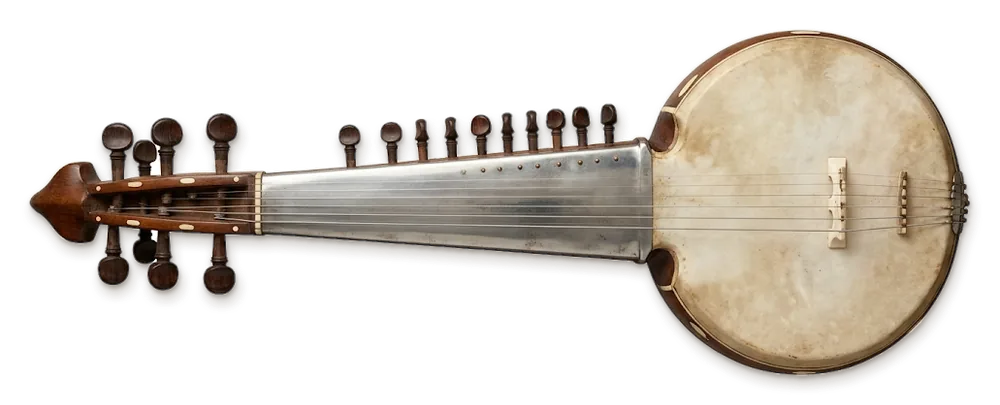
Tap a note to hear it and see where the finger stops the string (“Finger at”: how far down the string from the top).
Phrases of Raag Shree
- S r M P N Ṡ , Ṡ N d P M G r S
- r ⁀P ⁀r
- S r M P N Ṡ
- Ṡ N d P M G r S
- S Ṇ r , r r P
- P M P d M G r
- r P r G r S
Evening raga of the Purvi thaat, sung at dusk: komal Re and Dha, tivra Ma, with Rishabh and Pancham as the central pair, and Ga and Dha left out of the ascent.
Tap a phrase to hear it and watch the place on the string for each note as it sounds. Shree is known for its komal Re at its own shruti. Move that note in the player with the drone on and hear the difference.
The aroha and avaroha1,2, pakad2,3 and chalan2 in the player are the ones on Raag Shree’s own page.
Before you play Raag Shree
- Nothing to set: with no frets, every note of Shree (Sa, komal Re, Ga, tivra Ma, Pa, komal Dha and Ni) is where the nail stops the string on the fingerboard. The table gives each place as a share of the string's length from the top nut, the same arithmetic the picture uses.4
Where each note of Raag Shree is played
The distance from the top nut, as a share of the string’s whole length: a string stopped there sounds the note. The same arithmetic places the finger in the picture.
| Note | String | From the nut |
|---|---|---|
| S Sa | Sa string, open | open |
| r komal Re | Sa string | 5.6% |
| G Ga | Sa string | 20.6% |
| M tivra Ma | Ma string | 5.6% |
| P Pa | Ma string | 10.9% |
| d komal Dha | Ma string | 15.9% |
| N Ni | Ma string | 29.3% |
| Ṡ upper Sa | Ma string | 33.3% |
Komal Re in Raag Shree, on the sarod
Listen for the touch of Ga on Shree’s komal Re and the meend that joins Re and Pa in both directions. Those movements shape how Re is heard in the raag.6,7
In the reading of the 22 shrutis on the shrutis page, komal Re has steps at −10 and +12 cents from the keyboard's note. The lesson starts it at the keyboard's note, since the sources do not fix it: move it and listen against the drone.8
How the sarod plays a note between the keys
With no frets, a sarod player can slide freely between notes (meend). Nothing has to be moved for a raga's shruti: the hand stops the string where the ear wants the note, and a swing (andolan), a gentle movement around the note, is a slow slide of the stopping nail.4,5
How the sarod plays the notes
The sarod has no frets. On the Maihar sarod the four main strings are tuned Ma, Sa, low Pa and low Sa, as in the player, and the strings are pressed firmly against a polished metal fingerboard with the tips of the fingernails, or with nail and fingertip together.4
Keep going
- Raag Shree: its notes, time, mood, chalan, songs and sheets, played on a keyboard.
- The sarod: its parts, tuning, history and players, with lessons.
- Raag Shree on the sitar, the sarangi and the bansuri.
- More ragas on the sarod: Darbari Kanada, Todi, Bhairav, Adana, Bhimpalasi, Miyan ki Malhar.
Sources
The numbers in the text point to these sources. The phrases come from the raga’s own page, with the sources it cites. A teacher who can hear you play is still the best guide.
- V. N. Bhatkhande. Hindustani Sangeet Paddhati: Bhatkhande Sangeet Shastra, Bhag 3 (Hindi). Part 3, p. 41–49, 52.
- Tanarang (Acharya Vishwanath Rao Ringe). Raag Shree, Tanarang Music. p. web page.
- George Howlett. Shree, Hindustani Raga Index (Raga Jungle). p. web page.
- Wikipedia contributors. Sarod. Wikipedia.
- Wikipedia contributors. Andolan. Wikipedia.
- Rajan P. Parrikar. Raga Shree: Close Encounters. parrikar.org (first published on SAWF), 2001.
- Vishwanath Rao Ringe (Tanarang). Raag Shree. Tanarang Music.
- Wikipedia contributors. Shruti (music). Wikipedia.