
Sarangi सारंगी · Raag श्री
Raag Shree on the sarangi
Play Raag Shree on the sarangi
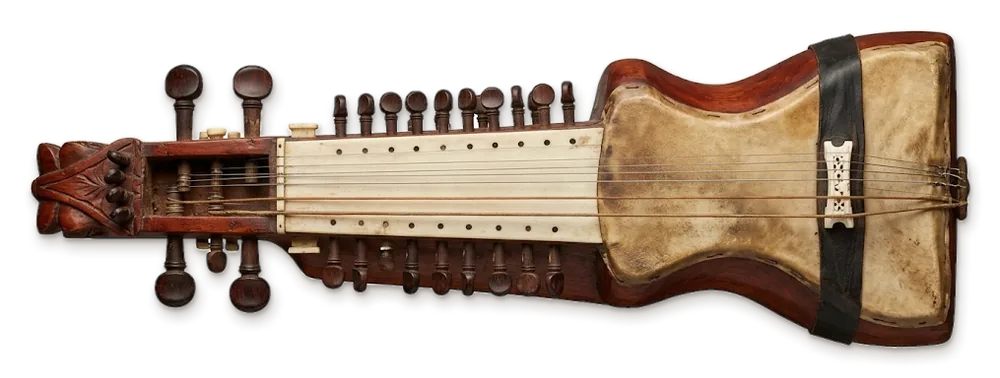
Tap a note to hear it and see where the finger stops the string (“Finger at”: how far down the string from the top).
Phrases of Raag Shree
- S r M P N Ṡ , Ṡ N d P M G r S
- r ⁀P ⁀r
- S r M P N Ṡ
- Ṡ N d P M G r S
- S Ṇ r , r r P
- P M P d M G r
- r P r G r S
Evening raga of the Purvi thaat, sung at dusk: komal Re and Dha, tivra Ma, with Rishabh and Pancham as the central pair, and Ga and Dha left out of the ascent.
Tap a phrase to hear it and watch the place on the string for each note as it sounds. Shree is known for its komal Re at its own shruti. Move that note in the player with the drone on and hear the difference.
The aroha and avaroha1,2, pakad2,3 and chalan2 in the player are the ones on Raag Shree’s own page.
Before you play Raag Shree
- Nothing to set: with no frets, every note of Shree (Sa, komal Re, Ga, tivra Ma, Pa, komal Dha and Ni) is where the nail touches the string. The table gives each place as a share of the string's length from the top nut, the same arithmetic the picture uses.4
Where each note of Raag Shree is played
The distance from the top nut, as a share of the string’s whole length: a string stopped there sounds the note. The same arithmetic places the finger in the picture.
| Note | String | From the nut |
|---|---|---|
| S Sa | Sa string, open | open |
| r komal Re | Sa string | 5.6% |
| G Ga | Sa string | 20.6% |
| M tivra Ma | Sa string | 29.3% |
| P Pa | Sa string | 33.3% |
| d komal Dha | Sa string | 37.0% |
| N Ni | Sa string | 47.0% |
| Ṡ upper Sa | Sa string | 50.0% |
Komal Re in Raag Shree, on the sarangi
Listen for the touch of Ga on Shree’s komal Re and the meend that joins Re and Pa in both directions. Those movements shape how Re is heard in the raag.6,7
In the reading of the 22 shrutis on the shrutis page, komal Re has steps at −10 and +12 cents from the keyboard's note. The lesson starts it at the keyboard's note, since the sources do not fix it: move it and listen against the drone.8
How the sarangi plays a note between the keys
It is prized because it can follow the ornaments of the human voice. The bow keeps the note sounding while the nail slides to any place on the string, so a shruti is wherever the ear puts it, and a swing (andolan) is the nail moving slowly along the string and back.4,5
How the sarangi plays the notes
The sarangi's three gut strings are bowed with a heavy horsehair bow and stopped not with the fingertips but with the nails, the cuticles and the skin around them, with talcum powder on the fingers so they slide.4
Keep going
- Raag Shree: its notes, time, mood, chalan, songs and sheets, played on a keyboard.
- The sarangi: its parts, tuning, history and players.
- Raag Shree on the sitar, the sarod and the bansuri.
- More ragas on the sarangi: Darbari Kanada, Todi, Bhairav, Adana, Bhimpalasi, Miyan ki Malhar.
Sources
The numbers in the text point to these sources. The phrases come from the raga’s own page, with the sources it cites. A teacher who can hear you play is still the best guide.
- V. N. Bhatkhande. Hindustani Sangeet Paddhati: Bhatkhande Sangeet Shastra, Bhag 3 (Hindi). Part 3, p. 41–49, 52.
- Tanarang (Acharya Vishwanath Rao Ringe). Raag Shree, Tanarang Music. p. web page.
- George Howlett. Shree, Hindustani Raga Index (Raga Jungle). p. web page.
- Wikipedia contributors. Sarangi. Wikipedia.
- Wikipedia contributors. Andolan. Wikipedia.
- Rajan P. Parrikar. Raga Shree: Close Encounters. parrikar.org (first published on SAWF), 2001.
- Vishwanath Rao Ringe (Tanarang). Raag Shree. Tanarang Music.
- Wikipedia contributors. Shruti (music). Wikipedia.