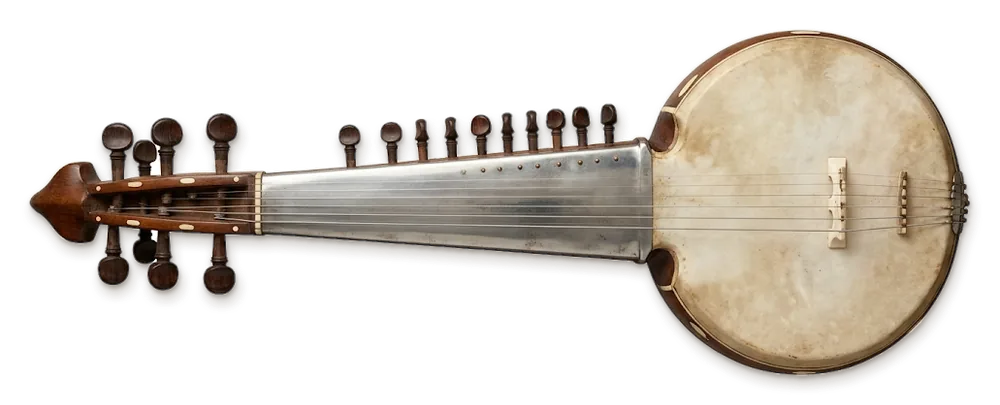
Tune the four main strings of a Maihar sarod, hold the java, and stop the strings on the bare metal fingerboard.
Play the sarod
StringSaSaसाFinger atOpen
Tap a note to hear it and see where the finger stops the string (“Finger at”: how far down the string from the top). More about Raag Yaman
By the end: You can tune the four main strings and play a clean note and a slide on the first string.
Step by step
On the Maihar sarod the four main strings are tuned Ma, Sa, low Pa and low Sa, which gives three octaves. Conventional sarods are traditionally pitched to B, the Maihar model to C.1
Pluck with the java, a small triangle of coconut shell, ebony or horn.1
There are no frets, so press the string firmly against the metal plate. Players use either the tips of the fingernails or the nail together with the fingertip.1
Because nothing stops the string between notes, slide along it to join them: this is the sarod's meend.1
Practise
Capital letters are shuddh notes; small r, g, d and n are komal, and M is tivra Ma. A dot above a note is the upper octave, a dot below it the lower one; a dash holds the note for another beat. How to read the notation.
Lesson 1 · you are hereTune the main strings and stop them with the nailTune the four main strings of a Maihar sarod, hold the java, and stop the strings on the bare metal fingerboard.