
The theka1,2
- Dha Dhin Dhin Dha | Dha Dhin Dhin Dha
- Dha Tin Tin Ta | Ta Dhin Dhin Dha
Clap on 1, 5 and 13 and wave on 9 while you say it.
Tabla तबला · lesson 3 of 3
Put the strokes together into the 16-beat theka of Teentaal, with the khali section played without the bayan's open sound.
Dha: right hand Na and left hand Ge
Play the tabla
By the end: You can play one full cycle of Teentaal, saying the bols and counting sam and khali.
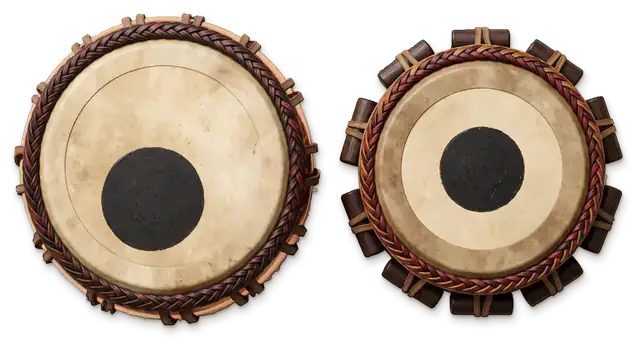
Tap a bol to hear it and see where the fingers land: the right hand plays the dayan, the smaller drum, and the left hand the bayan, the bigger one. These are the bols of the Teentaal theka.
right hand Na (open) + left hand Ge (open)
right hand Tin (open) + left hand Ge (open)
right hand Tin (open)
right hand Na (open)
Open. Index finger strikes the rim (kinar) and lifts; the ring and little fingers rest on the edge of the black patch. Bright and ringing, and soon gone.
Open. Index finger strikes the open skin just outside the black patch and lifts; the ring and little fingers rest as for Na. A softer tone that rings longer than Na.
Open. Index finger strikes the middle of the black patch (syahi) and lifts at once, with no finger resting. A deep, singing ring.
Open. The four fingers together strike the black patch and lift at once, so the drum rings under a soft slap.
Closed. Middle and ring fingers strike the middle of the black patch and stay down. Short and dry. Inside quick runs such as TiRaKiTa and TiTa; the Ta at the end of TiRaKiTa and KiTa is the same dry stroke, often with the ring and little fingers at the edge of the patch.
Closed. Index finger strikes the black patch and stays down. Short and dry, a little brighter than Ti.
Open. Middle and ring fingers strike the open skin beyond the black patch and lift, the wrist resting on the head. The bass rings.
Open. Ge, then the heel of the hand presses forward on the head so the bass slides up in pitch. Players add this slide by choice, often on the last bass stroke before sam; a written Ghe is usually a plain Ge.
Closed. The flat hand slaps the bayan and stays down. No ring, no bass.
Clap on 1, 5 and 13 and wave on 9 while you say it.
The numbers in the steps point to these sources. A teacher who can watch you play is still the best guide.
More about the tabla: its parts, tuning, history and players.