
Wind · Sushira · Double reed
Shehnai शहनाई
Also called shenai, sahnai
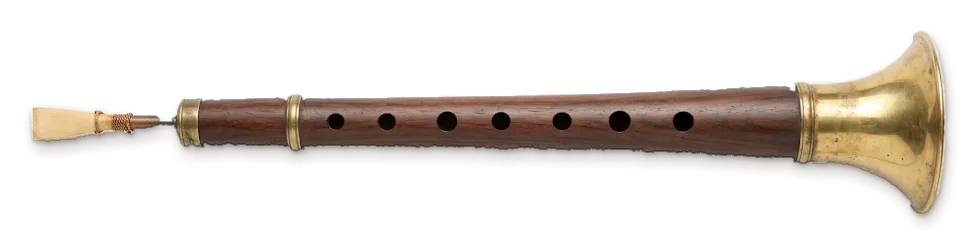
The shehnai is a wooden reed pipe with a flared bell, the sound of weddings and temple gates in North India and, since the 20th century, of the concert stage.1,3
Play the shehnai
HolesSaसाBreathGentle
Tap a note to hear it and see which holes are closed. The fingering shown is a simple one; players also shape notes with the lips and with part-covered holes. More about Raag Yaman
- Class
- Wind (Sushira)
- Sound
- Breath through a reed into a wooden pipe that widens into a bell
- Region
- North India
- Tradition
- Hindustani
Parts of the shehnai
A wooden pipe widens gradually towards a flared bell of metal or wood, with six to nine finger holes. Sources differ on the reed: Roychaudhuri describes double reeds like those of the oboe, while Wikipedia describes a set of four reeds.1,2
How the shehnai is held and played
Mastering it takes careful control of the lips and the fingers. Its range is about two octaves.1
The shehnai in the music
Roychaudhuri explains that the shehnai is never played alone: a second shehnai holds a drone on Sa and a small kettledrum keeps time. This group, the naubat or rosan chauki, once played from gateway music houses every three hours, and some temples still keep the custom.2
It is still played at religious festivals and weddings.1
History of the shehnai
It was one of the nine instruments of the Mughal court. Sources differ on the name: one legend has a barber (nai) improve the pungi for the shah's court, another reads it as "king's pipe" (shah and nai), and a third theory derives it from sur-nal, a melody pipe.1
Players who made the shehnai known
- Bismillah Khan: Made the shehnai a concert instrument.1,3
- Ali Ahmed Hussain Khan: Listed among the notable shehnai players.1
Sources and further reading
The numbers in the text point to these sources. Where they disagree, the text says so.
- Wikipedia contributors. Shehnai. Wikipedia.
- Bimalakanta Roychaudhuri. The Dictionary of Hindustani Classical Music. Motilal Banarsidass, Delhi, 2000, p. 177 ("Sahnai").
- Ustad Bismillah Khan. Darbar.